

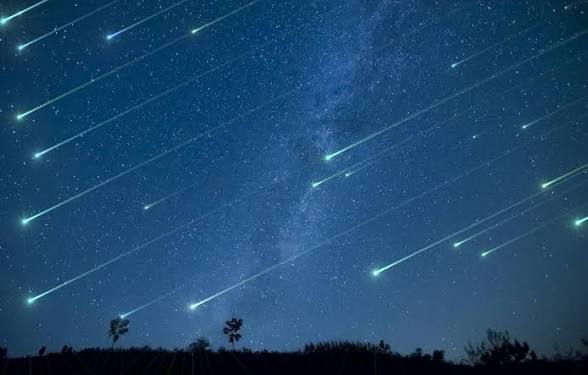
Mauritius Gets a Front-Row View of the Orionid Meteor Shower; Halley’s Comet Returns to the Spotlight as Orionids Peak Over Mauritius
The annual celestial display offers stargazers a chance to witness fragments of one of the most famous comets streaking across the night sky.
PORT LOUIS, Mauritius — Astronomy enthusiasts and curious observers across Mauritius have an opportunity to witness the annual Orionid meteor shower, a celestial spectacle produced by debris left behind by Halley’s Comet.
The shower is active in October, with the early hours of Thursday, October 22, offering a viewing opportunity for those willing to stay up late or rise before dawn. Mauritius is well positioned to observe the display because the constellation Orion, from which the meteors appear to radiate, is visible from the island.
The Orionids are among the better-known annual meteor showers, bringing a reminder that some of the most captivating astronomical events can be observed without telescopes or specialised equipment.
### Where and when to look
For observers in Mauritius, the most promising period is after midnight and before dawn on October 22. Orion rises in the east-northeast, making the northeastern sky a useful starting point for locating the shower.
However, there is no need to stare directly at Orion. Although the meteors appear to originate from a point near the constellation, they can streak across a much wider area of the sky. Looking upwards with a broad field of view offers a better chance of catching a passing meteor.
The Moon may interfere with observations earlier in the night, washing out some of the fainter streaks. If lunar conditions and local visibility permit, observing after moonset and before the first light of dawn should provide better contrast.
As with all meteor showers, the number of meteors actually seen will depend on cloud cover, atmospheric conditions, surrounding light and the observer’s location.
### The legacy of Halley’s Comet
The Orionids are created when Earth passes through a trail of dust and small particles left by Halley’s Comet. As these particles enter Earth’s atmosphere at speeds of approximately 66 kilometres per second, they heat up and produce the bright streaks commonly known as shooting stars.
Despite their appearance, these streaks are not stars falling from the sky. They are tiny particles burning up in the atmosphere, many of them no larger than grains of sand.
Under favourable dark-sky conditions, the Orionids can produce around 10 to 20 meteors per hour. This is an ideal rate rather than a guarantee: actual observations may be considerably lower, particularly when moonlight or clouds obscure the sky.
Halley’s Comet itself does not need to be visible for the shower to occur. Although the comet last passed through the inner Solar System in 1986, its debris continues to intersect Earth’s orbit every year. The comet is expected to return to the inner Solar System in 2061.
### Where to watch in Mauritius
For the clearest view, observers should seek locations with minimal artificial lighting, an open view of the sky and, ideally, limited cloud cover.
The southern and southwestern coastline, including the areas around Riambel and Maconde, may offer useful dark-sky conditions away from major urban centres. The Chamarel area and parts of the Black River Gorges region are other possibilities, provided access is permitted and conditions are safe.
Those staying in the north can also watch from a suitably dark, open location away from the brightest built-up areas. Travelling a long distance is not essential: even a garden or open space with limited surrounding lighting may be sufficient.
A few simple precautions can improve the experience:
* Allow about 20–30 minutes for your eyes to adapt to darkness.
* Avoid looking at your phone or other bright screens while observing.
* Watch with the naked eye rather than through binoculars or a telescope, which restrict the field of view.
* Choose a safe, accessible spot and avoid exposed cliffs or isolated coastal areas at night.
The Mauritius Meteorological Services' can help observers plan around lunar conditions.
### A quiet reminder of the wonders above us
The Orionid meteor shower is more than a fleeting astronomical event. It is an opportunity to pause and look beyond the familiar rhythms of daily life, towards a universe whose movements have fascinated humanity for generations.
For Mauritius, where the night sky can be obscured by urban lighting and modern distractions, the shower offers a simple invitation: step outside, find a dark patch of sky and look up.
The display may not produce a spectacular streak every few seconds, and patience will be essential. But even a single bright meteor can make the wait worthwhile.
As Earth crosses the ancient trail of Halley’s Comet, the skies over Mauritius will share in a cosmic encounter repeated year after year — a reminder that the universe is still full of wonders visible to anyone willing to look.
Views: 13