

Elon Musk’s latest social media outburst over Starlink’s delayed launch in India is a revealing display of billionaire entitlement: when the doors to a lucrative market do not open on his preferred timetable, the world’s richest entrepreneur appears ready to question who really runs the country.
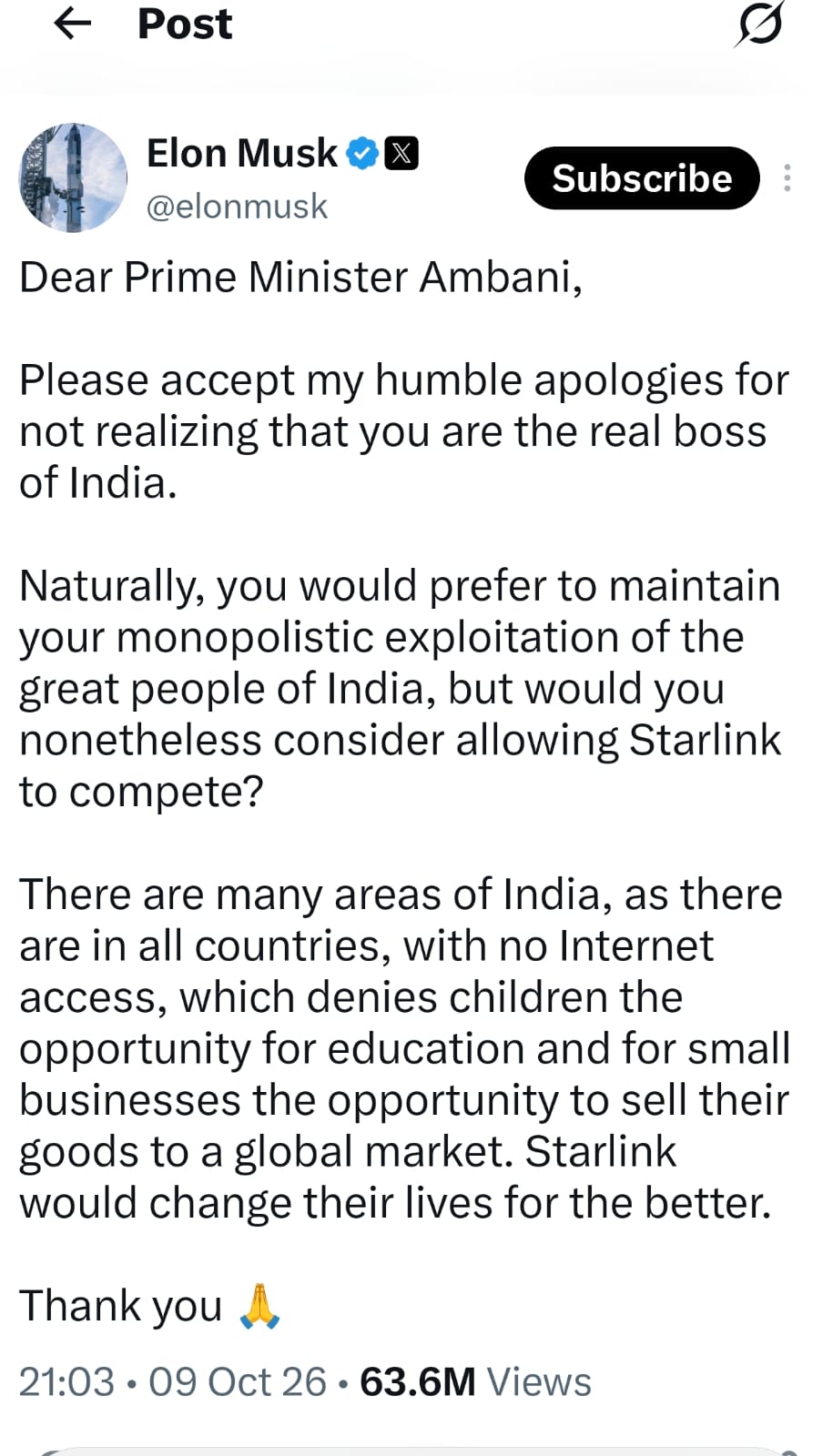
On Thursday, Musk asked whether industrialist Mukesh Ambani was “the real boss of India”. On Friday, he escalated the sarcasm, addressing Ambani as “Prime Minister Ambani” and accusing him of seeking to preserve monopolistic exploitation. The insinuation was unmistakable: that India’s regulatory process was being manipulated to prevent Musk’s satellite internet business from competing. Yet Musk has offered no publicly established evidence to substantiate that allegation. “Reuters” (https://www.reuters.com/business/media-telecom/india-rejects-monopoly-claim-after-musk-accuses-ambani-blocking-starlink-launch-2026-10-09/) “Indian Express” (https://indianexpress.com/article/business/elon-musk-apologises-to-ambani-for-not-he-is-the-real-boss-of-india-10914705/)
There is a word for this sort of performance: arrogance. And when it comes from a businessman seeking access to one of the world's largest telecommunications markets, it deserves to be challenged.
India is not a private fiefdom. Its government is not an executive committee answerable to a technology billionaire. Nor does a company acquire an automatic right to operate simply because its founder commands a vast fortune, a global platform and an army of online admirers.
Musk is entitled to demand transparency. He is entitled to challenge unreasonable delays. He is entitled to compete. What he is not entitled to do is substitute insinuation for evidence and then present a sovereign country's regulatory decisions as a personal affront.
The rules are not optional
Starlink, operated by Musk's SpaceX, has spent years preparing to enter India. It has obtained important regulatory authorisations, established infrastructure and formed partnerships with Reliance Jio and Bharti Airtel. Yet commercial operations remain pending while security assessments and spectrum-related requirements are completed.
On October 8, India's Ministry of Communications rejected suggestions that the process was discriminatory. It said all three satellite communication operators at the relevant stage were undergoing security assessments and were broadly at the same regulatory stage. The government maintained that the framework was fair and non-discriminatory. “Business Standard” (https://www.business-standard.com/industry/news/govt-rejects-elon-musk-starlink-discrimination-claims-satellite-internet-india-126100800210_1.html)
That distinction matters. A licence or preliminary authorisation is not a blank cheque to begin commercial operations without satisfying the remaining conditions.
Satellite communications are not merely another consumer gadget. They involve infrastructure that crosses borders, radio spectrum, data flows and questions of national security. A government has a legitimate responsibility to determine how such networks operate within its jurisdiction, how sensitive information is protected and whether security requirements can be enforced in practice.
These obligations do not disappear because an applicant happens to be Elon Musk.
If Starlink has met every applicable requirement and is still being held back without a defensible reason, the government should explain the outstanding obstacles and resolve them promptly. Administrative delay should not become a permanent obstacle to competition. But the proper remedy is transparent regulation, not a social media spectacle designed to embarrass the host country into submission.
The irony of preaching freedom while demanding entry
Musk's argument is wrapped in the language of competition and public service. He says satellite internet could connect underserved communities, help children access education, enable small businesses to reach global markets and provide communications when disasters disrupt conventional networks.
These are legitimate potential benefits. Remote villages, isolated communities and disaster-prone regions can gain enormously from reliable connectivity. India should assess Starlink on its technical capabilities, public value, affordability and compliance with the law.
But a worthy objective does not excuse an unproven accusation.
Musk's claim that unnamed oligarchs are blocking Starlink to protect their monopolistic position may resonate with audiences already suspicious of corporate influence. Yet the allegation is not proof of collusion. India has multiple competing interests in its telecommunications sector, and its government says the relevant satellite operators are subject to comparable security assessments.
There is also an uncomfortable irony in watching one of the world's most powerful business figures denounce alleged oligarchic control while using his own enormous public influence to pressure a government.
If the concern is monopoly, the answer should be consistent competition policy. If the concern is regulatory delay, the answer should be a transparent timetable. Neither requires the theatrics of pretending that a billionaire's commercial disappointment is evidence of a national conspiracy.
Sovereignty is not hostility to business
India should welcome investment, innovation and competition. Its enormous geography makes satellite connectivity a potentially valuable complement to fibre and mobile networks, particularly where conventional infrastructure is difficult or uneconomic to deploy.
But welcoming a business is not the same as surrendering the right to regulate it.
The principle is straightforward: foreign companies may bring capital, technology and expertise, but they must operate under the laws and legitimate security requirements of the country in which they seek to do business. That standard applies to American companies in India just as it applies to Indian companies seeking access to the United States.
No serious defender of free enterprise should confuse predictable rules with hostility to commerce. Indeed, transparent and consistently enforced regulation is what allows genuine competition to flourish without giving any single corporation privileged treatment.
The Indian government must therefore hold two positions at once. It must resist pressure to grant Starlink special treatment, while also ensuring that bureaucratic inertia or domestic commercial interests do not unfairly obstruct its entry. Sovereignty should never become a cover for arbitrary administration, just as competition should never become a pretext for corporate intimidation.
The standard must be the same for everyone.
India’s citizens are not props in a billionaire’s feud
Perhaps the most troubling aspect of Musk's rhetoric is the way it invokes India's underserved citizens as supporting characters in a dispute over commercial access.
The digital divide is real. Children without reliable internet deserve better opportunities. Small businesses deserve affordable connectivity. Remote communities deserve infrastructure that does not leave them isolated from education, healthcare and economic participation.
But these people should not be used as rhetorical ammunition in a contest between billionaires and regulators.
Nor should the arrival of satellite broadband be automatically equated with universal affordability. The eventual value of Starlink in India will depend on equipment costs, subscription prices, coverage, service quality and the alternatives available to consumers. Its potential contribution deserves serious evaluation rather than either uncritical celebration or reflexive rejection.
The question is not whether Musk can portray himself as the champion of India's poor. It is whether Starlink can deliver meaningful public benefits while meeting India's lawful requirements.
That is a question for evidence, policy and performance—not sarcasm on X.
A country does not need permission to govern itself
India's response should be measured, firm and transparent. If Starlink has outstanding security obligations, the government should specify them and process the application within a reasonable period. If the company has fulfilled its obligations, it should not face indefinite uncertainty. And if the rules are being applied inconsistently, the remedy should be institutional accountability.
What India should not do is allow the size of a corporate fortune or the volume of a social media following to determine the standards under which a strategic industry operates.
Musk has built extraordinary businesses and helped advance technologies that were once considered improbable. Those achievements deserve recognition. They do not confer political authority over another country's regulatory decisions.
The larger lesson extends far beyond Starlink. In an era when private technology companies possess extraordinary financial resources and global communications platforms, democratic governments must preserve their capacity to act in the public interest without being bullied by corporate power.
India can welcome Starlink without worshipping its founder. It can encourage competition without abandoning security. It can demand accountability from its own regulators without accepting unsupported accusations from a foreign billionaire.
Elon Musk may own a company seeking entry into India. He does not own the Indian market, its regulatory institutions or its sovereignty.
India's doors can remain open to innovation without its government bending the knee to wealth. That is not hostility to business. It is the minimum standard of national self-respect.
Views: 4