

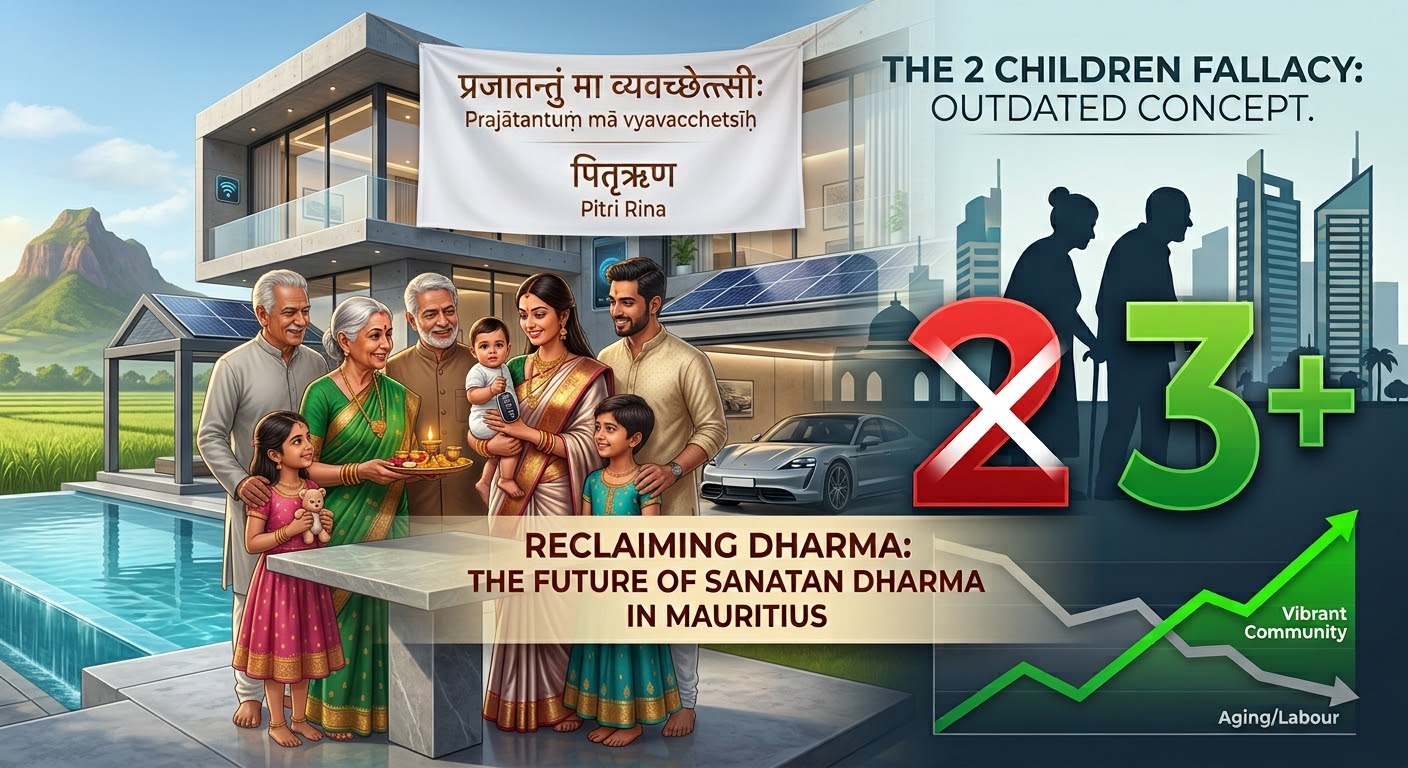
1. The Pride of the Arya-Sanatani Householder.
Across generations, the Hindu community in Mauritius has built a legacy of resilience. From the arduous days of early indenture to establishing vibrant temples, grand festivals, and professional excellence, family life has remained the bedrock of our society. Modern parents work tirelessly to provide their children with the best education, financial security, and a proud cultural identity.
However, a subtle paradox has emerged in our quiet, comfortable homes. While we invest heavily in grand religious ceremonies, lavish weddings, and personal success, our collective demographic footprint is quietly receding.
2. The Mathematical Illusion: Why “2.1” Does Not Mean Two Children
Many well-meaning parents believe that having two children is enough to maintain our society. This relies on a fundamental misunderstanding of demographic science:
* The Replacement Myth: A replacement fertility rate of 2.1 is a macro-level population average. It accounts for individuals who remain unmarried, couples who cannot have children, and premature mortality.
* The Reality: If every married couple strictly limits themselves to two children, the net population is guaranteed to decline.
* The Mauritius Picture: With total fertility rates in Mauritius hovering around 1.4 to 1.5, clinging to the 1970s slogan of “Hum Do, Humare Do” is demographic negligence. While our youth base shrinks and our population ages, other communities maintain robust multi-child family structures.
When former Minister of Gender Equality and Family Welfare, Hon. Kalpana Koonjoo-Shah, sounded the alarm on our shrinking population, she faced sharp media criticism; proving that the belief of having few children is deeply ingrained in Mauritius. Yet, her warning was rooted in stark demographic data: a community that fails to reproduce at replacement levels eventually surrenders its political voice, cultural influence, and social stability.
3. Dismantling the Economic Shield: State Infrastructure
The most common objection to larger families is economic: “We simply cannot afford a third child.” Yet, Mauritius today offers unprecedented state-sponsored support mechanisms designed specifically to ease the financial responsibilities of parenting:
* Direct Monthly Allowances: CSG Child Allowances and monthly School Allowances (Rs 2,000 per child).
* Zero Tuition Costs: Universal free education spanning pre-primary, primary, secondary, and state tertiary university levels.
* Workplace Support: Statutory obligations requiring mandatory day-care/crèche facilities for employers with headcounts above 250.
* Youth Independence Support: A direct grant of Rs 20,000 provided to every youth upon turning 18.
* Expanding Horizons: Proposed enhancements including Rs 5,000 schooling allowances and direct stipends for stay-at-home mothers.
When baseline education, healthcare, and financial allowances are covered by the state, limiting a family to two children is often a choice to prioritize discretionary luxury over family continuity.
4. The Scriptural Mandate: Beyond Rituals to Duty (Dharma)
Can ritual participation (Kriya) replace our obligation to perpetuate our lineage? Classical Vedic jurisprudence addresses this directly through the doctrine of the Three Debts (Trina).
A. The Unpayable Debt to Ancestors (Pitri Rina)
The Taittiriya Samhita of the Krishna Yajurveda establishes that human existence carries an intrinsic structural obligation:
> जायमानो वै ब्राह्मणस्त्रिभिर्ऋणवा जायते ब्रह्मचर्येण ऋषिभ्यो यज्ञेन देवेभ्यः प्रजया पितृभ्यः।
> Jāyamāno vai brāhmaṇas tribhir ṛṇavā jāyate brahmacaryeṇa ṛṣibhyo yajynena devebhyaḥ prajayā pitṛbhyaḥ.
> Translation: “A person at birth is born with three debts: to the Sages by sacred study (Brahmacharya), to the Gods by sacrifice (Yajna), and to the Ancestors by offspring (Praja).”
>
A householder who funds grand rituals pays the debt to the Gods (Deva Rina), but completely defaults on the debt to the Ancestors (Pitri Rina) by capping their family at an arbitrary modern limit. Furthermore, the Taittiriya Upanishad (Shikshavalli, Anuvaka 11) commands graduating students:
> प्रजातन्तुं मा व्यवच्छेत्सीः। (Prajātantuṁ mā vyavacchetsīḥ.)
> Translation: “Do not cut off the continuous thread of lineage and progeny.”
>
B. The Bhagavad Gita on Lineage Collapse (Kulasakshaya)
The teachings of Bhagavan Krishna in the Bhagavad Gita provide an extensive sociological and spiritual warning regarding what happens when a community allows its lineages to wither away.
In Chapter 1, Verses 39 to 42, Arjuna articulates the disastrous systemic consequences of Kulasakshaya (the destruction of family lineage):
> कुलक्षये प्रणश्यन्ति कुलधर्माः सनातनः।
> धर्मे नष्टे कुलं कृत्स्नमधर्मोऽभिभवत्युत॥
> Kulakṣaye praṇaśyanti kuladharmāḥ sanātanāḥ |
> dharme naṣṭe kulaṁ kṛtsnam adharmo 'bhibhavaty uta ||
> Translation: “With the destruction of the lineage, the eternal family traditions (Sanatana Kuladharma) perish; and when righteousness is destroyed, unrighteousness (Adharma) overtakes the entire family and society.”
>
> अधर्माभिभवात्कृष्ण प्रदुष्यन्ति स्त्रियः कुलस्त्रियः।
> स्त्रीषु दुष्टासु वार्ष्णेय जायते वर्णसंकरः॥
> Adharmābhibhavāt kṛṣṇa praduṣyanti striyaḥ kulastriyaḥ |
> strīṣu duṣṭāsu vārṣṇeya jāyate varṇa-saṅkaraḥ ||
> Translation: “From the prevalence of unrighteousness, O Krishna, the women of the family become corrupted; and when women are corrupted, unwanted progeny (Varna-sankara) arises.”
>
> संकरो नरकायैव कुलघ्नानां कुलस्य च।
> पतन्ति पितरो ह्येषां लुप्तपिण्डोदकक्रियाः॥
> Saṅkaro narakāyaiva kulaghnānāं kulasya ca |
> patanti pitaro hy eṣāṁ lupta-piṇḍodaka-kriyāḥ ||
> Translation: “Such indiscriminate population shifts lead the family and the slayers of the lineage to hell, for the ancestors fall, deprived of their offerings of food and water (Pindodaka).”
>
The Deeper Application of the Gita's Warning:
While traditional commentaries apply these verses to the literal chaos of war, the philosophical principle is intensely structural:
* The Loss of Custodianship: When families deliberately shrink below survival levels, the number of individuals trained in Kuladharma (family ethics, transmission of sacred knowledge, and heritage) collapses.
* Starvation of the Ancestors: The text notes that when descendants vanish, ancestral rites (Shraddha / Tarpanam) stop. In Hindu cosmology, this breaks the spiritual continuity between past and future generations.
* The Rise of Adharma: A demographic vacuum is never left empty. When one community retreats demographically out of comfort or adherence to outdated foreign slogans like “Hum Do, Humare Do,” the cultural and institutional space is inevitably filled by other forces, leading to the eclipse of Sanatana Dharma.
Conclusion: Securing the Next Generation
A culture does not live in stone temples or bank accounts; it lives in human beings.
Giving your children wealth and education is commendable, but the greatest protection you can give them is a strong, youthful, and populous community. By moving past the outdated two-child norm, utilizing available state support, and embracing families with three or more children, Mauritian householders fulfill their highest spiritual duty (Dharma) to their ancestors, their heritage, and their nation.
Views: 8