

“To the next generation, believe that you can make a difference—but remember that meaningful
change begins with how you treat the person in front of you. Be curious, work with discipline,
act with integrity, and let compassion guide your ambitions.
In any field, keep learning, welcome guidance, and do not be afraid to ask for help. Setbacks are
not proof that you cannot succeed; they are opportunities to grow and begin again.
Let your success be measured not only by what you achieve, but also by how you contribute to
the well-being of others. Your ideas, choices, and acts of service matter. Stay true to your values,
care for your own well-being, and have the courage to turn your hopes into action.”
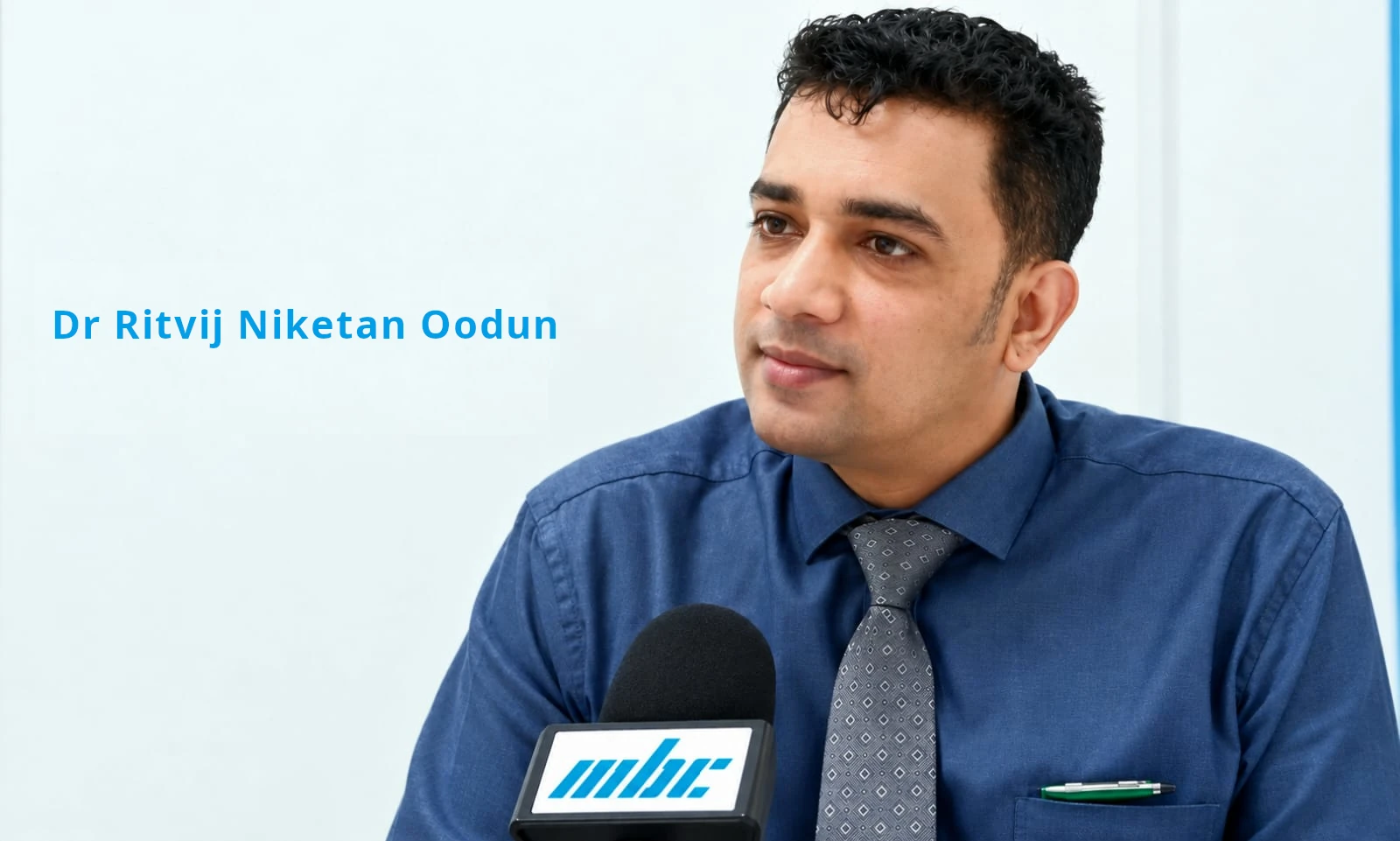
In today’s “Inspirational Leader” chronicle, we meet Dr Ritwij Niketan Oodun, a dedicated professional from the public medical sector, who works as Consultant Pyschiatrist at the Ministry of Health and Wellness, while also involving himself deeply and selflessly in social work, both nationally and internationally. We hope his achievements and values are an inspiration to youths who might wish to join the public medical sector. His ideas and thoughts are presented verbatim below:
Section 1: Basic Profile & Professional Identity
Full Name & Preferred Name:
Dr Oodun Ritwij Niketan
Current Role / Title:
Consultant Psychiatrist Ministry of Health & Wellness, Part Time Lecturer in Psychiatry and Public
Mental Health in the faculty of Medicine & Health Sciences, University of Mauritius, Tutor in Forensic
Psychiatry and Community Based Rehabilitation at Mauritius Institute of Health
Primary Organization, Institution, or Field:
Ministry of Health and Wellness Mauritius.
Location / Base of Operations:
Republic of Mauritius
Section 2: The Spark & Cultural Roots
The Spark: What originally inspired you to step into your field, and how did your personal journey
begin?
“My journey into psychiatry began with a deep curiosity about how people think, feel, and find their way
through difficult experiences. I was drawn to the idea that listening with care, understanding someone’s
story, and offering the right support could make a meaningful difference—not only to an individual, but
also to their family and community.
During my medical training, I saw how profoundly mental health affects every part of life, and how often
people struggle in silence because of stigma or lack of support. Those experiences strengthened my
commitment to this field. Psychiatry gave me the opportunity to bring together science, compassion, and
human connection.
Over time, that commitment grew beyond clinical care to include teaching and community engagement.
I’m inspired by the possibility of helping people feel heard, supporting future professionals, and building a
society where mental health is treated with understanding and dignity.”
Rooted in Values: How have your cultural heritage, core values, or spiritual philosophy shaped
your approach to leadership and professional excellence?
Values such as Dharma—living with purpose and responsibility—sewa—serving others—and compassion
have shaped my approach to medicine and in the academic pathways as lecturer and mentor. As a
Consultant Psychiatrist and Lecturer in the Department of Medicine, I see these values reflected in
listening without judgment, treating every person with dignity, and sharing knowledge so that others may
grow. In psychiatry especially, compassion matters: behind every diagnosis is a human being deserving of
understanding, hope, and care.
Professional excellence is not only about what you achieve; it is also about how you achieve it. Work with
discipline and perseverance, act with integrity, and remain humble enough to keep learning. Let your
beliefs guide your conduct while evidence and thoughtful inquiry guide your decision.
Whatever path you choose, use your talents in service of something larger than yourself. Your heritage can
be a source of wisdom, not a boundary; your values can be a compass, not a limitation. Lead with courage,
learn with humility, and remember that even small acts of care can change someone’s life.
Section 3: Major Milestones & Innovation
Key Achievements & Breakthroughs: What are 2–3 key milestones, historic firsts, major
projects, or breakthroughs in your career or path so far?
“Three important milestones have shaped my journey so far:
- Becoming a Consultant Psychiatrist: This was a significant professional milestone and a
commitment to providing thoughtful, evidence-based care to people experiencing mental health
challenges. - Combining clinical practice with teaching:Becoming a Lecturer has allowed me to share
knowledge, mentor future healthcare professionals, and help prepare the next generation to
deliver compassionate, informed care. - Connecting mental health care with community needs: A central focus of my work has been
promoting understanding, challenging stigma, and encouraging people to seek support. I see
this as an ongoing effort—one that brings together clinical care, education, and community
engagement.
These milestones matter to me not simply as career achievements, but because they create
opportunities to support individuals, strengthen the healthcare workforce, and contribute to a
more informed and compassionate society.”
Unique Perspective & Innovation: What makes your approach unique?
“What makes my approach distinctive is my effort to connect three areas that are often treated
separately: clinical care, education, and community engagement. As a Consultant Psychiatrist
and Lecturer, I aim not only to support people in clinical settings, but also to equip future
professionals and help communities understand mental health and seek support earlier.
I combine evidence-based practice with compassionate, person-centred listening, recognizing
that each person’s experiences, relationships, and circumstances matter. I also believe that
meaningful mental health care must be accessible and respectful of the communities it serves.
By encouraging open conversations and challenging stigma, I hope to help bridge the gap
between professional services and everyday community life.
For me, innovation is not always about creating something entirely new. It can also mean
making existing knowledge more accessible, connecting people to support sooner, and ensuring
that care is grounded in dignity, understanding, and practical action.”
Section 4: Real-World Impact & Overcoming Challenges
Tangible Impact: How has your work, initiative, or leadership positively impacted your industry,
local community, environment, or society at large?
“My work has a tangible impact through the people I support, the future professionals I teach, and the
conversations I help bring into the community. In clinical practice, I work to provide compassionate,
evidence-based care that helps people feel heard, access appropriate support, and take meaningful
steps toward well-being.
As a Lecturer, I contribute to preparing future healthcare professionals to approach mental health
with knowledge, empathy, and respect. Beyond clinical and teaching settings, I aim to promote
understanding, challenge stigma, and encourage earlier help-seeking—particularly among young
people and communities that may face barriers to care.
The impact is not always captured in numbers. It can be seen when someone feels safe enough to ask
for help, when a learner carries a more compassionate approach into their practice, or when a
community begins to speak about mental health more openly. These individual changes can build into
a broader shift toward a more informed, supportive, and inclusive society.”
Overcoming Barriers & Resilience: Describe one major challenge, setback, or skepticism you faced along your
path, and how you stayed grounded to overcome it.
“One of the continuing challenges in my work has been confronting the stigma and misconceptions that
can prevent people from seeking mental health support. At times, people may delay reaching out because
they fear being judged, do not recognize what they are experiencing, or are unsure where to turn. It can be
difficult to see those barriers stand between someone and timely care.
I stay grounded by focusing on the purpose behind the work: helping people feel heard and supported,
and contributing to a more informed and compassionate approach to mental health. I rely on evidence
based practice, learn from colleagues and the communities I serve, and remind myself that progress often
happens gradually. A thoughtful conversation, a student who carries greater understanding into their
work, or one person reaching out earlier can all be meaningful steps forward.”
Work & Life Harmony: How do you sustain your energy, passion, and inner balance while
navigating demanding professional and personal responsibilities?
I believe work–life harmony is not about giving equal time to everything every day; it is about
giving each responsibility our full attention, guided by a clear sense of purpose. In a demanding
profession, I try to care for my own well-being as conscientiously as I care for others. Yoga and
meditation help me pause, steady my mind, and return to work with greater clarity and
compassion. Time with family, continued learning, and selfless service to society keep me
grounded and remind me why my work matters. There will always be pressures and imperfect
days. The aim is not to do everything, but to remain present, know when to seek support, and
make space to renew ourselves. A balanced individual is better able to serve a family, a
profession, and a nation.
My message to our nation and the youth is simple: let us build a culture where ambition is
matched by well-being, and achievement by compassion. When we care for our minds and
bodies—and use our strengths in service of others—we can sustain not only our own energy, but
also the hope and resilience of the communities we serve.
Section 5: Values, Vision & Message to Youth
Guiding Philosophy: What core principles, ethics, or personal tenets guide your daily actions and
decision-making process?
“My daily decisions are guided by a simple principle: do what is right, not merely what is easy or
convenient. I try to act with integrity, compassion, humility, and a strong sense of
responsibility—values deeply connected to Dharma and Sewa, the call to live purposefully
and serve others.
In medicine, this means listening carefully, treating every person with dignity, and letting
evidence, ethics, and empathy guide my judgment. As a lecturer and leader, it also means
remaining open to learning and helping others reach their potential.
Before making an important decision, I ask myself: Is it honest? Is it fair? Will it genuinely help?
These questions keep me grounded. I believe that when our principles are clear, our actions
become more meaningful—and our success becomes something we can share with others.”
Message to the Next Generation:
What encouraging message or advice do you have for young
people aspiring to make a difference in your domain or in society?
“To the next generation, believe that you can make a difference—but remember that meaningful
change begins with how you treat the person in front of you. Be curious, work with discipline,
act with integrity, and let compassion guide your ambitions.
In any field, keep learning, welcome guidance, and do not be afraid to ask for help. Setbacks are
not proof that you cannot succeed; they are opportunities to grow and begin again.
Let your success be measured not only by what you achieve, but also by how you contribute to
the well-being of others. Your ideas, choices, and acts of service matter. Stay true to your values,
care for your own well-being, and have the courage to turn your hopes into action.”
Future Vision: What is your next major goal, milestone, or initiative for the coming years?
“My vision is to help build a nation where mental health is understood, valued, and supported as
an essential part of overall well-being—and where no one has to face emotional distress alone.
As a Consultant Psychiatrist and Lecturer, my goal is to make care more accessible and
compassionate, challenge stigma, and encourage people—especially young people and
underserved communities—to seek support early. I hope to bring clinical care, education, and
community engagement closer together by equipping future healthcare professionals,
strengthening the networks that support people, and turning awareness into meaningful action.
I will continue to learn and work in line with evidence-based practice.
To our youth, I say: you are not only the future of this country; you are shaping it today. Your
empathy can help someone feel seen, your courage can begin an important conversation, and
your service can strengthen your community. You do not need to wait for a position of influence
to make a difference.
A stronger nation is built not only through economic progress, but also through the health,
dignity, and potential of its people. Let us create a society where asking for help is seen as a sign
of strength, compassion is put into action, and everyone has the opportunity to learn,
contribute, and thrive. That is the future I am committed to helping build—one person, one
community, and one meaningful step at a time.”
Section 6: Media & Background Material
Short Biography / CV Summary:
Dr. Ritwij Niketan OODUN, Consultant Psychiatrist at SSRN Hospital with more than 21 years of
experience in medicine and over 13 years of service in social and cultural initiatives. A 2006 registered
General Medical Practitioner and 2013-registered specialist in Doctor of Medicine in Psychiatry , with an
MD earned in Psychiatry at Banaras Hindu University, supported by a scholarship from the Governments
of India to Mauritius. He has served in hospitals across Mauritius and lectured in psychiatry, child
psychiatry and public mental health at the University of Mauritius and the Open University of Mauritius.
His additional qualifications include a diploma in disaster and combat mental health and yoga teacher
training.
As President of SEWA International Mauritius, he spearheads initiatives promoting education,
wellbeing and support for vulnerable communities.
Views: 41