

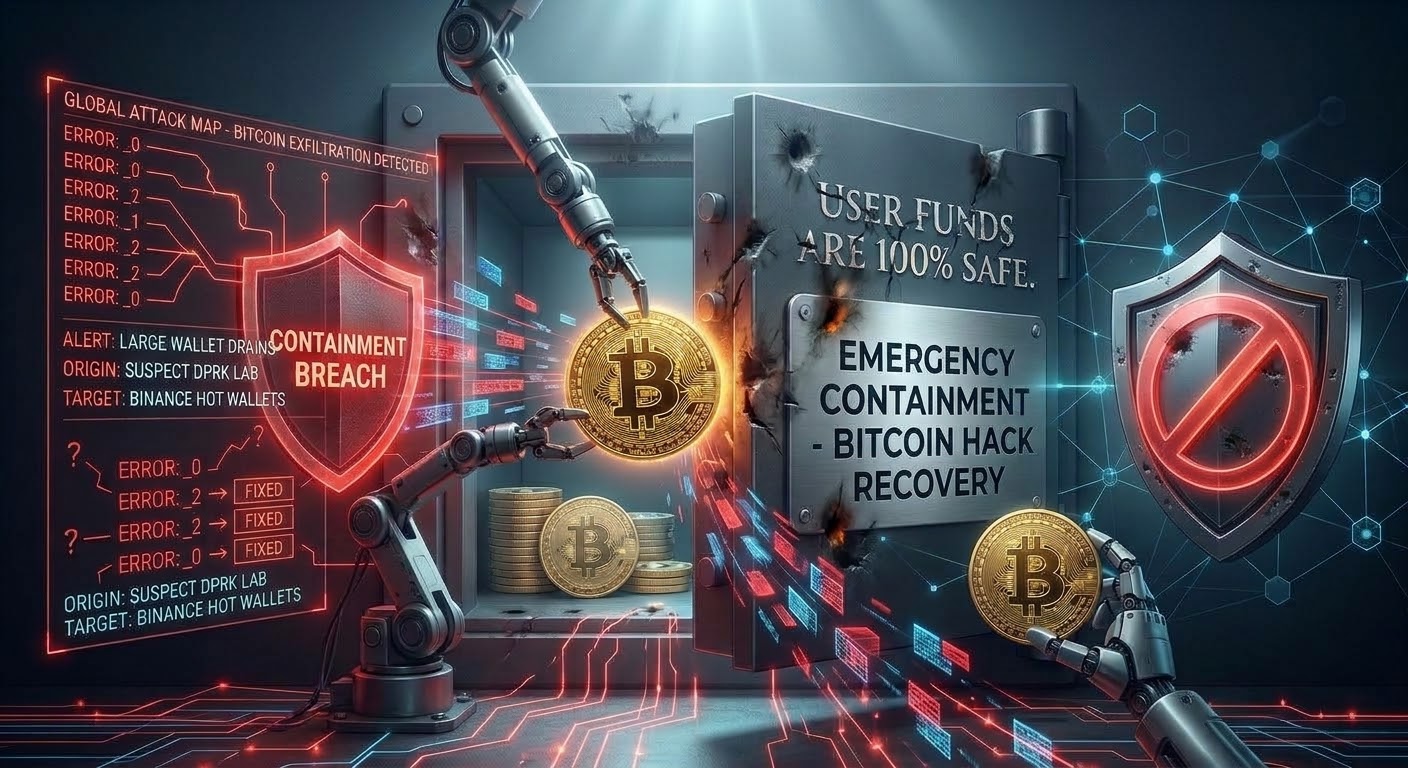
The cryptocurrency industry was rocked by the largest heist in its history. On October 29, 2026, an attacker executed a high-speed exploit targeting Binance’s hot wallets, draining an estimated $5.9 billion to $6.4 billion in assets across 10 blockchains in roughly 20 minutes.
This single breach eclipsed all prior crypto exploits, standing nearly four times larger than the $1.5 billion Bybit hack.
Here is a full breakdown of how the exploit occurred, the identity of the perpetrators, how the industry responded, and what this means for Binance users.
At a Glance: Key Details of the Hack
* Total Assets Drained: ~$6.36 Billion to $6.43 Billion across 10 distinct blockchains.
* Speed of Attack: The vast majority of funds were transferred in under 20 minutes.
* Frozen Assets: Approximately $2.7 billion to $2.8 billion in stolen assets were swiftly frozen on-chain through coordinated efforts.
* Impacted Tokens: Tether (USDT), Ethereum (ETH), Circle USD (USDC), Uniswap (UNI), Chainlink (LINK), and several others.
* User Fund Guarantee: Binance and co-founder Changpeng Zhao (CZ) confirmed that user funds are 100% safe, backed by the Secure Asset Fund for Users (SAFU) and corporate reserves.
How the $6.4B Binance Exploit Unfolded
The attack was a highly coordinated, automated operation designed to bypass standard exchange safeguards.
1. Initial Access & Infrastructure Compromise
Initial findings indicated that the attack began with a DevOps engineer’s endpoint compromise (likely through targeted spear-phishing or malicious code hidden in dummy projects). This allowed the attacker to gain access to internal service containers.
2. Service Container Manipulation
Rather than cracking or leaking raw wallet private keys, the threat actors leveraged internal permissions to interact directly with hot wallet signing infrastructure. On Ethereum, the attacker used EIP-7702 delegation to turn a hot wallet into an automated sweeper using pre-signed authorizations. On nine other chains, parallel batch withdrawal calls swept tokens in quick succession.
3. Automated Capital Laundering
In a bid to stay ahead of automated blacklist scripts, the attacker swapped over $325 million in stablecoins to ETH within minutes. On-chain data from Chainalysis and TRM Labs revealed that laundering scripts automatically created thousands of intermediate wallets (many initialized with tiny test amounts like 1 TRX) to split and redistribute funds instantly.
Who Was Behind the Attack?
Leading blockchain intelligence firms, including Chainalysis, TRM Labs, and Elliptic, have attributed the attack with high confidence to TraderTraitor—an elite state-sponsored cybercrime unit tied to North Korea (DPRK).
Key Evidence Linking DPRK:
* Commingled On-Chain Funds: Stolen funds from the Binance breach were directly merged with wallets used in prior North Korean operations, including a major exploit on Bitget.
* Signature TTPs: The combination of social engineering targeting developers, automated bridge usage, and EIP delegation patterns matches known tactics utilized by TraderTraitor.
Industry Response: The $2.8 Billion Freeze
While the scale of the attack was massive, the crypto ecosystem’s emergency response set new records for incident mitigation:
* Stablecoin Issuers: Tether (USDT) and Circle (USDC) froze over $1.56 billion and $800 million in assets respectively within an hour of the exploit.
* DeFi Protocols & Layer 2 Networks: The Arbitrum Security Council along with protocols like Aave moved quickly to freeze additional tens of millions in ETH and ARB tokens on layer-2 networks.
* Binance Operations: Binance temporarily halted withdrawals across affected networks to revoke compromised authorizations, patch container security boundaries, and conduct endpoint audits.
Are User Funds Safe on Binance?
Yes. Both Binance leadership and co-founder Changpeng Zhao (CZ) confirmed that no retail users will suffer net losses as a result of the breach.
Binance maintains the Secure Asset Fund for Users (SAFU)—an emergency insurance fund capitalized with real assets specifically designed for catastrophic events. The combination of SAFU and corporate balance sheet liquidity will fully cover the net unrecovered balance.
Key Takeaways for Crypto Investors
Exchange Hot Wallets Remain Vulnerable: Even top-tier exchanges can face compromises through supply chain or DevOps entry points.
Self-Custody is Essential: Keeping active trading funds on exchanges is necessary for trading, but long-term holdings belong in hardware cold storage wallets.
Real-Time On-Chain Countermeasures Are Working: The ability of issuers and L2 security councils to lock nearly half the stolen funds ($2.8B) within hours demonstrates how on-chain security coordination has matured.
Views: 9