
Once, before the bullets and betrayals, Kashmir was not just a place—it was a pulse. The cradle of Indian civilization. Sharada Peeth, one of the oldest seats of learning, stood there proudly, long before Oxford or Harvard were even imagined. Great Hindu sages, philosophers, and scientists walked its sacred soil. Kalhana penned history here. Abhinavagupta contemplated the cosmos here. Kashmir was not a “disputed territory”—it was a jewel in Bharat’s soul.
Then came 1990. The night when Kashmir’s skies turned dark with hate. The mosques didn’t call for prayer that night—they roared with a command:
“Raliv, Galiv, ya Chaliv” — Convert, Die, or Leave.
This was not a conflict. It was not an exodus. It was a genocide.
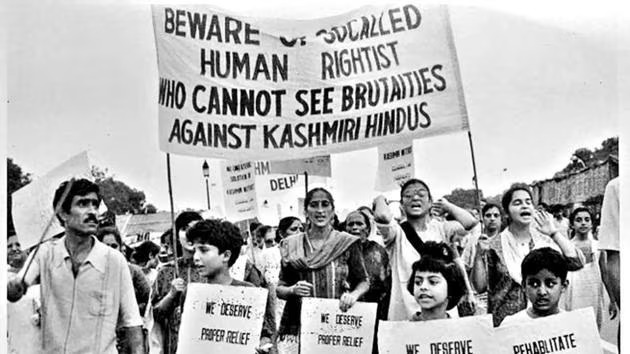
Hindu homes marked. Sisters dragged out. Mothers raped in front of their sons. Men tied to sawmills, hacked and fed into machines. Temples defiled. Pandits hunted like animals in the land of their ancestors. Nearly 400,000 driven into exile. And yet—who was called the oppressor?
The murderers donned the garb of martyrs. They spoke of ‘Azadi’.
Freedom from what? From their Hindu neighbours? From the Constitution that gave them equal rights?
They silenced the real victims and raised slogans of revolution.
They rewrote history with the blood of those they butchered—and the world believed them.
And while India wept, it still gave space for dialogue. For peace. For healing.
And in 2019, it finally took a step that should have come decades earlier: it buried Article 370.
Not to oppress, but to equalize. To bring Kashmir into the fold of modern India. One law, one right, one people.
But peace doesn’t sit well with those who profit from chaos.
In April 2025, Pahalgam—a place of serenity—was stained red. Twenty-six Hindu tourists were gunned down. Not in crossfire. Not in some accidental ambush. They were checked for their religion. And then executed. One by one.
Is this a freedom struggle? Or a purity ritual of hatred?
No masked soldier. No political spin. Just plain, cold-blooded terrorism. But when have the murderers ever owned their crimes? They first took credit, then retreated behind silence. Just like in 1990. Just like always.
Pakistan, meanwhile, smiles behind the veil of ceasefire. While terrorists cross the border and bullets cross the LOC. India honours peace on paper. Pakistan violates it on ground. But who is called the aggressor?
Where is the global outrage? Where are the cries for justice?
Why is Hindu blood so cheap?
And now, as the fires rage once again in the Valley, there are Hindus—yes, Hindus—asking if India is the aggressor.
Have we lost our memory? Or just our courage?
India is not perfect. But India is not the villain of this tale.
India is the mother who never gave up on her estranged child.
Even when that child spat in her face. Even when her other children were slaughtered in silence.
This article isn’t just about Kashmir. It’s about conscience.
To all Hindus:
Will we continue to be gaslit into silence?
Will we let lies wear the robes of morality?
Or will we finally speak our truth—not with hate, but with unflinching clarity?
Kashmir is not a battlefield.
It is a wound.
And wounds, when denied, rot.
But when remembered, they become scars of strength.
Let us not forget. Let us not forgive blindly. Let us rise—not in anger, but in awareness.
Because the truth is no longer a whisper—it is a roar waiting to be heard.
VoxSolar
Views: 2