

DOMESTIC ABUSE BILL
Interview with Mrs Kalpana D. Koonjoo-Shah
Former Minister of Gender Equality and Family Welfare of the Republic of Mauritius
By the Dharmic Times Editorial Board
EDITOR'S INTRODUCTION
During a ministerial tenure marked by the COVID-19 pandemic, mounting social pressures and the persistent challenge of gender-based violence, Mrs Kalpana D. Koonjoo-Shah oversaw an extensive programme of reform in child protection, family welfare and the prevention of domestic abuse.
The legislative architecture for a new Domestic Abuse Bill was formally initiated and substantially developed during her stewardship of the Ministry. Cabinet approval was obtained, drafting instructions were issued, a working draft was prepared and stakeholder consultation commenced before she left office in November 2024. The Bill has since completed its passage through the National Assembly.
In this interview, the former Minister welcomes the legislation while insisting, with characteristic candour, that the historical record must be stated accurately. She reflects upon the origins of the reform, the round-the-clock protection services maintained during the pandemic, the institutional measures introduced under her tenure and the formidable task of converting legislative promise into practical safety for victims.
Dharmic Times is pleased to welcome Mrs Kalpana D. Koonjoo-Shah.
The National Assembly has unanimously passed the Domestic Abuse Bill. As the former Minister under whose tenure this reform was initiated, what is your immediate reaction?
The unanimous passage of the Domestic Abuse Bill is, above all, a victory for victims and survivors whose suffering has too often remained concealed behind closed doors. It is a national acknowledgement that domestic abuse is not a private peccadillo, a family disagreement or an inconvenience to be managed in silence. It is a grave violation of human dignity, an assault upon the safety and autonomy of the victim and a matter of compelling public concern.
I therefore welcome this parliamentary milestone unequivocally.
At the same time, it is important to situate the reform within its proper historical and institutional continuum. Legislation of this breadth is not conceived, drafted and perfected overnight. It is the product of sustained policy development, executive decision-making, the necessary travaux préparatoires, legal drafting, consultation and the painstaking work of public officers, police officers, social workers, legal advisers, civil society organisations and front-line professionals.
During my stewardship of the Ministry, we embarked upon a root and branch review of the Protection from Domestic Violence Act. Our purpose was unambiguous: to replace an ageing, repeatedly amended statute with a modern and coherent framework capable of addressing the complex and evolving manifestations of domestic abuse.
It is a source of profound personal and professional satisfaction to see that work reach this stage. Yet, I have never regarded a national reform as the property of a Minister. Good government rests upon la continuité de l'État. One administration may lay the foundations and complete the greater part of the structure; another may bring the measure through its final parliamentary stages. What matters ultimately is that the Republic advances and that victims receive the protection they have long deserved.
Why was there a compelling need for entirely new legislation rather than further amendments to the Protection from Domestic Violence Act?
The Protection from Domestic Violence Act of 1997 was a pioneering measure for its time. It gave Mauritius its first dedicated statutory framework for domestic violence and was strengthened by amendments in 2004, 2007, 2011 and, significantly, 2016. It would be both legally unsound and historically unjust to pretend that it achieved nothing.
The difficulty was that social and legal understanding had moved considerably beyond the framework within which the original Act had been conceived. We now understand far more clearly that abuse is not confined to physical assault. It may be psychological, emotional, sexual or economic. It may consist of intimidation, surveillance, stalking, isolation, deprivation, coercion or the calculated use of technology to monitor, threaten or humiliate a victim.
These are not always isolated episodes. Very often, they form part of a sustained pattern by which one person progressively dominates another, extinguishes her independence and deprives her of control over her own life.
After successive amendments, the existing statute no longer offered the most coherent vehicle for addressing those realities. The ratio legis, that is, the governing purpose of our reform was therefore not to place another patch upon an old garment, but to fashion a comprehensive and internally consistent framework suited to contemporary forms of abuse.
The Bill accordingly widens the statutory conception of domestic abuse to include physical, sexual, emotional, psychological and economic abuse, as well as threatening, controlling and coercive conduct and abuse committed through electronic means. It shifts attention beyond an isolated blow or threat and permits the law to confront a pattern of conduct that undermines a victim's safety, dignity and autonomy.
When did the substantive work on the reform begin, and how far had it progressed when your mandate ended?
The substantive work began well before the present administration assumed office, and the chronology is a matter of documentary record rather than political interpretation.
Following policy deliberations within the Ministry, Cabinet formally approved the preparation of new legislation to replace the Protection from Domestic Violence Act on 14 July 2023. Engagement with the State Law Office followed, including a meeting in August 2023 to address the legal issues arising from the proposed Bill. Drafting instructions were issued, and the State Law Office submitted a working draft on 22 March 2024.
Consultation with governmental and non-governmental institutions then proceeded in relation to that working draft. By the conclusion of my mandate, the policy direction had been settled, Cabinet authority had been secured, the drafting process had been activated, a substantive working draft existed and the inter-institutional consultation process was under way.
I do not claim that every procedural stage had been exhausted. Further refinement, validation and consultation remained before the Bill could be introduced in Parliament. That is the ordinary course of serious legislative work.
But by any fair and objective assessment, the bulk of the policy development, executive approval, initial drafting and foundational consultation had been accomplished during my tenure. I say this neither as an exercise in self-congratulation nor as a claim to proprietorship. I say it because the public record matters, and because the considerable labour of the officers and institutions involved should not be written out of history.
The Prime Minister stated that the previous Government lacked the political will to bring the Bill. How do you respond, and how should credit properly be apportioned?
With respect, je ne peux souscrire à cette lecture. I must therefore demur, firmly and on the record.
I have no appetite for an unseemly quarrel over personal credit, particularly on a subject as grave as domestic abuse. But neither will I acquiesce in an account that effaces the work of an entire Ministry and the professionals who carried it forward.
Political will is not a rhetorical flourish or an exercise of 'tape la table'. It is evidenced by executive action. It is demonstrated by taking a proposal through Cabinet and obtaining formal authority to draft a new law. It is demonstrated by issuing drafting instructions, engaging the State Law Office, producing a working Bill and convening institutions whose cooperation is indispensable to implementation.
Those steps occurred. They are recorded. They cannot be made not to have occurred merely because an election intervened before the measure reached the floor of the House.
The present Government deserves recognition for completing the remaining drafting and consultation, introducing the Bill and securing its parliamentary passage. I acknowledge that contribution without reservation. What I reject is the suggestion that the reform sprang fully formed into existence after November 2024.
The accurate account is both more generous and more dignified. The reform was conceived, authorised and substantially developed under one administration and completed through Parliament under another. These are successive stages of a single national undertaking, not mutually exclusive claims.
Legislation of this importance belongs to the Republic. Yet institutional continuity must never become a pretext for institutional amnesia.
During the debates, the former Act was described as a “toothless tiger”. Is that a fair legal or historical assessment?
It is a political caricature, not a balanced legal or historical assessment.
The 1997 Act was, for its time, a landmark statute. It introduced dedicated remedies and a legal vocabulary for conduct that had too often been dismissed as a private family matter. It was later strengthened as experience revealed gaps and as society's understanding of abuse evolved.
No responsible person would contend that the former Act was perfect. Had it remained wholly adequate, there would have been no reason for my Ministry to initiate its replacement. But it is equally wrong to describe as worthless a framework that afforded legal remedies and a measure of protection to victims for more than two decades.
Law is not static. Social behaviour evolves, technology creates new avenues of control, and institutions learn from the shortcomings exposed by experience. Legislative reform is therefore an act of evolution, not an admission that everything which preceded it was devoid of value.
Our work did not begin from a blank page. We built upon the existing foundations, identified their limitations and sought to construct a more resilient and comprehensive system. I wholeheartedly support the stronger framework now before the country. I simply refuse to endorse the denigration of the law, the institutions and the professionals upon whose experience that stronger framework was built.
What human reality lay behind your determination to reform the law, particularly in relation to femicide?
This Bill is not an academic exercise. Behind its clauses are women living in perpetual fear, children who witness violence in the place where they should feel safest and families required to carry trauma across generations.
Femicide is the most extreme and irreversible manifestation of violence against women. It is seldom without antecedents. In many cases it is the final act in a longer continuum of threats, coercion, humiliation, stalking, assault and control.
During my tenure, we were confronted with deeply distressing cases in which abuse culminated in death. Such tragedies engage a profound devoir de vigilance on the part of the State. They oblige us to ask searching questions. Were the warning signs recognised? Was the risk assessed with sufficient urgency? Did the relevant agencies communicate? Was the victim able to obtain immediate protection and safe accommodation? Did financial dependence leave her with no realistic means of escape?
The consequences extend far beyond the woman who is killed. Children may lose one parent to violence and the other to imprisonment. They may suffer psychological injury that affects their education, emotional development, relationships and future wellbeing.
The latest joint estimates of UNODC and UN Women indicate that approximately 50,000 women and girls were killed by intimate partners or other family members in 2024 — nearly one every ten minutes. Africa recorded the highest estimated rate of intimate-partner or family-member femicide.
Modern domestic-abuse legislation must therefore do more than punish visible violence after the event. It must enable institutions to recognise patterns, identify escalating risk and intervene before abuse reaches its fatal conclusion.
The ultimate objective is stark but simple: fewer women living in terror, fewer children inheriting trauma and fewer families mourning a death that might have been prevented.
Beyond the Bill itself, what do you regard as the principal institutional achievements of your tenure in this field?
The Bill was one component, an indispensable component, of a broader, victim-centred strategy.
My conviction was that a victim does not require law in the abstract. She requires an effective system capable of responding to her legal, psychological, medical, financial and accommodation needs, often within a matter of hours.
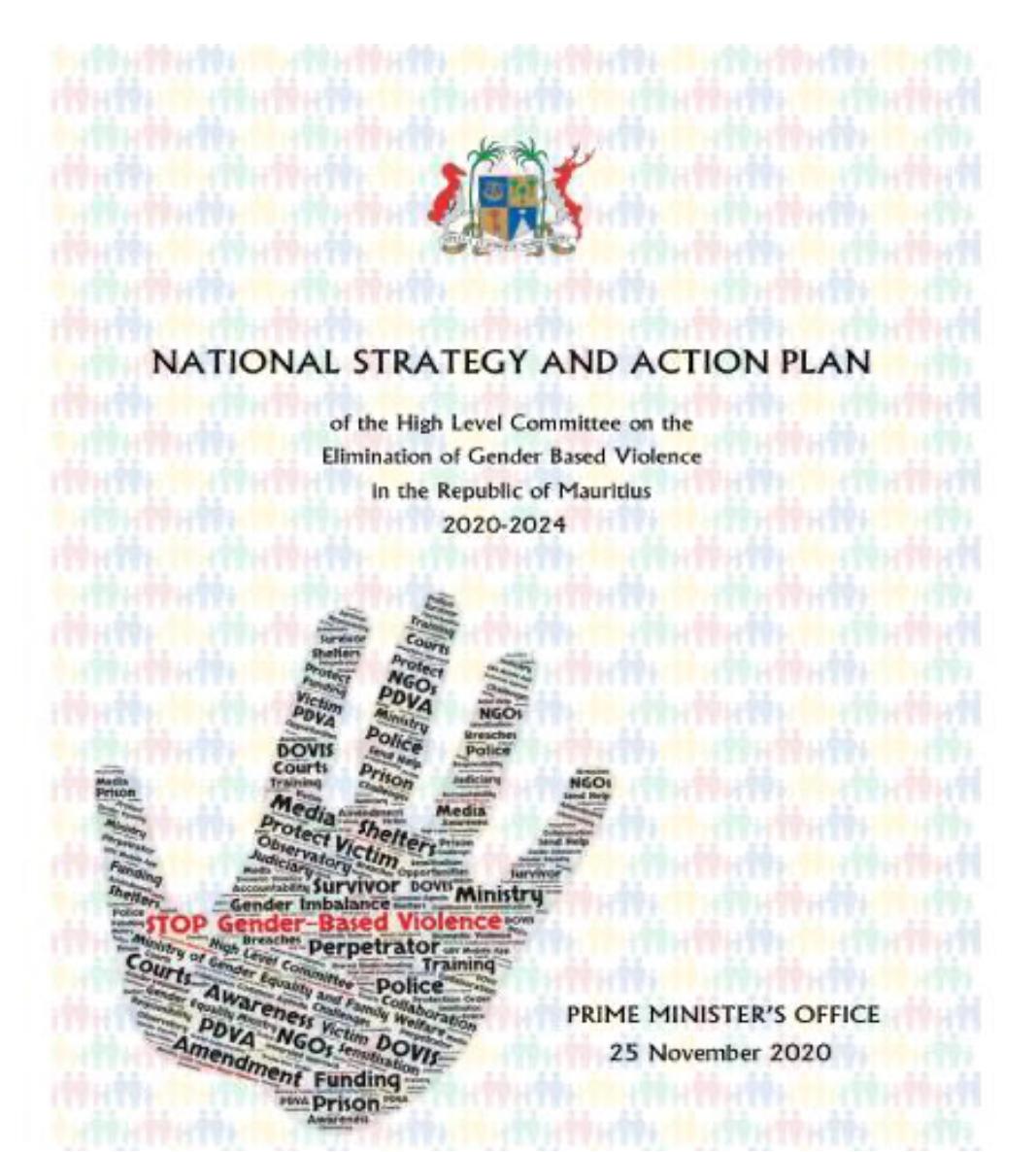
We established the High-Level Committee on the Elimination of Gender-Based Violence under the chairmanship of the Prime Minister and launched the National Strategy and Action Plan 2020-2024. We developed and launched the Lespwar mobile application to facilitate discreet reporting and rapid access to assistance. We strengthened the use of the Domestic Violence Information System, including its extension to Rodrigues, and promoted closer case coordination between the Ministry and the Police.
We moved the service model towards integrated Family Support Services, where Ministry officers and the Police could work from the same premises. We strengthened shelter support, economic empowerment measures, counselling, public awareness and collaboration with international partners.
I attach particular importance to that institutional shift. Victims should not be required to travel from office to office, repeat traumatic experiences to successive officials and attempt to coordinate the State's response themselves. The system must organise itself around the victim; the victim must not be left to organise the system.
The enduring contribution of my tenure, I hope, was to move domestic abuse from the margins of ministerial administration to the centre of a coordinated, whole-of-government protection policy.
The COVID-19 pandemic confined many victims at home with their abusers. How did the Ministry preserve protection and access to justice during that emergency?
The pandemic was one of the severest tests our protection system had ever faced.
Lockdown was necessary for public health, but for a victim of domestic abuse, the instruction to remain at home could carry a terrible irony: the home itself might be the place of greatest danger. Confinement increased isolation, reduced access to relatives and support networks, intensified financial anxiety and made it more difficult to seek help without alerting the perpetrator.
The figures illustrate the gravity of the situation. Statistics Mauritius recorded 520 domestic-violence cases between 20 March and 30 May 2020, involving 481 female victims and 39 male victims. One hundred and eleven victims left the conjugal home during the lockdown period.
We therefore took an unequivocal position: protection services were essential services and could not be permitted to retreat behind the restrictions of the pandemic. Domestic abuse does not observe office hours, and neither could the State's response.
The Ministry maintained protection, assistance and emergency intervention for survivors of gender-based violence and children at risk on a twenty-four-hour, seven-day-a-week basis. Hotline services remained operational, and our officers worked in close collaboration with the Mauritius Police Force, shelter providers and the Judiciary. The Ministry's official performance report expressly records that these services were sustained throughout the emergency.
Where a person faced immediate danger, our duty did not end with the receipt of a telephone call. Officers coordinated rescue and removal where required, facilitated safe accommodation, provided psychosocial assistance and helped victims obtain the court orders necessary for their protection.
Even when ordinary court operations were disrupted, urgent l'accès à la justice was preserved. District Magistrates remained available through technological means for urgent matters involving children and victims of domestic violence. As Minister, I can attest that we went so far as to facilitate protection-order applications through remote procedures and videoconferencing arrangements with magistrates where circumstances required it. Technology became the bridge between a victim in danger and the judicial protection to which she remained entitled.
That standard received international recognition. An account hosted by the United Nations Office on Drugs and Crime highlighted the Mauritian Judiciary's use of technological means to preserve urgent access to justice during COVID-19. A subsequent publication of the Inter-Parliamentary Union and UN Women cited Mauritius's High-Level Committee and National Strategy and Action Plan among the national experiences and promising practices considered in the global response to violence against women and girls during the pandemic.
I mention that recognition not for ceremonial praise, but because it validates an important principle: even in a national emergency, the rights and safety of victims cannot be placed in abeyance. COVID-19 taught us that domestic-abuse and child-protection services must be embedded permanently within national emergency planning.
Why was the creation of the Family Support Service such a pivotal reform?
The experience of seeking protection can itself become bewildering and exhausting. A victim may need police intervention, assistance from a Family Welfare and Protection Officer, psychological support, legal advice, medical care and emergency accommodation — sometimes all within the same day.
To require a traumatised person to navigate a succession of offices, repeatedly recount the abuse and reconcile different institutional procedures is to risk inflicting a form of secondary victimisation.
That is why the launch of the first Family Support Service at Abercrombie on 26 November 2022 was so significant. Pursuant to a formal operating procedure, officers of the Ministry's Family Welfare and Protection Unit and officers of the Police Brigade pour la Protection de la Famille worked from the same premises. The Police addressed enforcement and immediate safety; Ministry officers provided psychosocial intervention, counselling, referral and assistance with protection measures.
The model was then extended to Port Louis, Rose Hill, Phoenix, Souillac and Bambous during my tenure, with the objective of creating genuinely integrated services across the country.
This was not a cosmetic change of name or office. It represented a fundamental change in institutional philosophy. Instead of obliging the victim to move between agencies, we brought the agencies together around the victim.
That is what victim-centred public service should mean in practice.
It was suggested during the debates that shelters and support services under the former administration were poorly managed or inadequately resourced. How do you answer that criticism?
Broad and dismissive assertions of that kind do a disservice to the professionals who laboured daily within those services and to the survivors who found safety there.
I would invite those who make such claims to engage seriously with the shelter system, to speak with the officers and NGOs responsible for its operation and, subject always to privacy and safeguarding, to understand the experience of the residents themselves.
I remain immensely proud of the work undertaken to professionalise and humanise those services. We did not regard survivors as passive objects of pity. We sought to treat them as persons possessing agency, dignity and the capacity to rebuild their lives when provided with safety, counselling, training and opportunity.
We increased support to shelters and placed greater emphasis upon skills development and economic empowerment. That emphasis was deliberate. Financial dependence is one of the most formidable barriers preventing a victim from leaving an abusive relationship. A protection order may provide immediate legal security; durable freedom often depends upon the ability to support oneself and one's children.
Economic independence can therefore be one of the most enduring forms of protection available to a survivor.
No system is beyond scrutiny, and no Minister should be defensive about evidence-based criticism. But legitimate scrutiny is quite different from indiscriminate disparagement. I shall always defend the professional integrity of the social workers, police officers, psychologists, shelter staff and NGO partners who formed the vanguard of that effort.
How should the relationship between domestic abuse, substance misuse and economic hardship be understood?
The first principle must be stated without qualification: responsibility for abuse lies with the perpetrator. Poverty does not cause a person to abuse, and substance misuse does not excuse violence, intimidation or coercive control.
Nevertheless, those factors can heighten risk and deepen vulnerability. Substance misuse may contribute to volatility, financial instability and unpredictable behaviour within a household. Severe economic pressure may intensify tension and, more importantly, deprive the victim of a viable route to safety.
A woman may recognise the danger yet remain unable to leave because she has no independent income, no secure accommodation and children whose immediate needs must be met. Economic abuse may strengthen that captivity by preventing her from working, withholding money, controlling bank accounts or placing debt in her name.
We must therefore address the wider social environment without confusing explanation with exoneration.
A robust law is indispensable, but law alone cannot eradicate domestic abuse. It must be supported by effective drug-prevention and treatment policies, social protection, accessible housing, economic empowerment, mental-health services and sustained education directed at attitudes of domination and entitlement.
Otherwise, the State risks becoming proficient at processing cases after harm has occurred while remaining insufficiently equipped to prevent the next tragedy.
You welcome the Bill, yet remain concerned about implementation and funding. What, precisely, troubles you?
My concern is the chasm that can open between the law as enacted by Parliament and the law as experienced by the victim. A statute may be impeccable de jure and yet fail the victim de facto.
Legislation is not self-executing. Its efficacy will be determined by the daily decisions of police officers, Family Welfare and Protection Officers, magistrates, prosecutors, psychologists, medical practitioners, social workers and shelter personnel.
The Bill expands the statutory conception of abuse, strengthens judicial remedies, promotes information-sharing and risk management, provides for rehabilitation programmes and creates further duties and offences. These reforms are welcome. They are also operationally exacting and financially consequential.
The 2026-2027 Budget provides Rs 10 million for new shelters, specialised caregiver training and a halfway home, and it announces a Gender-Based Violence Coordination Committee. Those measures are positive and should be acknowledged.
But the implementation of this legislation cannot sensibly be reduced to a single allocation. It will require continuing and specialised training for the Police and all relevant professionals; additional Family Welfare and Protection Officers; greater shelter and emergency-accommodation capacity; clinical psychologists and trauma counsellors; accessible legal assistance; credible rehabilitation programmes for perpetrators; secure, interoperable digital case-management systems; public education; and independent monitoring of performance and outcomes. Adequate resourcing is not incidental to implementation; it is its sine qua non.
To date, I have not seen a comprehensive, publicly available and fully costed implementation plan identifying the resources required, the institution responsible for each obligation, the timetable for delivery and the measures by which success will be judged.
That omission is not a minor administrative detail. It is the central question upon which the worth of the legislation will ultimately depend.
Rights proclaimed without the capacity to deliver them may offer reassurance in the statute book but disappointment at the police station, in the courtroom or at the shelter door. The financial commitment to implementation must therefore be commensurate with the ambition of the Bill.
Why do Family Welfare and Protection Officers require particular attention under the new framework?
They constitute one of the principal pillars of the protection architecture.
These officers already carry demanding responsibilities in domestic abuse, family welfare and child protection. Their work calls for sound judgement, emotional resilience and the capacity to intervene in circumstances that may be highly complex, traumatic and occasionally dangerous.
As the law broadens the duties and expectations placed upon the protection system, the State must determine whether staffing, training and operational support have increased in proportion.
Have additional posts been created and filled? Has specialist, accredited training been delivered on coercive control, economic abuse, digital abuse and structured risk assessment? Are officers equipped for the additional documentation, coordination and follow-up that the new framework will require? Is psychological support available to professionals who are repeatedly exposed to traumatic material?
My concern has never been the commitment of the officers. A remarkable and seasoned head of department currently leads them. Their dedication is exemplary. My concern is a system that may continue to enlarge their legal responsibilities without furnishing the human and material resources necessary to discharge them properly.
We cannot place ever-greater statutory obligations upon front-line professionals, deny them the corresponding support and then make them the sole repository of blame when an under-resourced system fails. The State owes a correlative duty not only to the victim, but also to the officers upon whom the practical fulfilment of the victim's rights depends.
What was the purpose of the High-Level Committee chaired by the Prime Minister, and does its apparent discontinuation concern you?
Domestic abuse is a complex social and criminal wrong that cannot be addressed effectively by one Ministry acting within the confines of its own jurisdiction.
That was precisely why the High-Level Committee on the Elimination of Gender-Based Violence was established under the chairmanship of the Prime Minister. It brought together the institutions whose decisions directly affected prevention, protection and enforcement, including Gender Equality, the Police, Justice, Health, Education and Social Protection.
The Prime Minister's chairmanship was not ceremonial. It gave the subject the authority required to overcome administrative inertia, compel cooperation and establish accountability across Government.
The Committee elevated domestic abuse from a marginalised concern of a single Ministry to a national, whole-of-government priority. It also provided the leadership under which the National Strategy and Action Plan 2020-2024 was launched.
I note that the current Budget announces a Gender-Based Violence Coordination Committee. Any mechanism that genuinely improves inter-agency cooperation is welcome. But its value will depend upon its authority, chairmanship, frequency of meeting, access to data, power to assign responsibility and ability to require action from the institutions represented upon it.
Coordination is not achieved by nomenclature. The raison d'être of any such committee must be action: leadership, clearly assigned obligations, measurable targets and sustained oversight at the highest level.
Whether through the former High-Level Committee or an equally authoritative successor, domestic abuse must remain a matter for the centre of Government. High-level coordination is not a bureaucratic luxury; it is an operational necessity if we are serious about recognising danger earlier and preventing avoidable deaths.
What would genuine success look like to you?
Success will not be measured by the number of pages in the statute book, nor by the eloquence of the speeches delivered during the parliamentary debate.
Its true measures will be human.
Success will mean fewer women living in continuous fear within their own homes and fewer children witnessing violence in the place where they should feel most secure.
It will mean victims reporting abuse because they trust the Police, the courts and social services to respond promptly, sensitively and effectively. It will mean protection orders issued without needless delay and enforced with rigour. It will mean safe accommodation being available when a victim makes the perilous decision to leave.
It will mean institutions sharing information responsibly so that an escalating pattern is recognised before it becomes lethal. It will mean evidence-based rehabilitation programmes that confront abusive conduct while never diluting accountability.
Ultimately, success will be reflected in fewer women losing their lives to domestic and gender-based violence.
That must remain our shared, non-negotiable and supra-partisan national objective.
A final reflection?
I sincerely and wholeheartedly welcome the passage of the Domestic Abuse Bill.
We must, however, remain under no illusion: parliamentary passage is not the conclusion of this journey. It is the commencement of its most exacting phase.
The Bill is a solemn promise to victims, and that promise must now be redeemed through action. The energy devoted to presenting and passing the legislation must be matched — and indeed surpassed — by the determination devoted to its implementation, its mise en œuvre in the fullest sense.
Victims of domestic abuse, and the memory of those whom we have lost, deserve more than legislative declarations. They deserve institutions that respond with urgency and humanity. They deserve professionals who are properly trained, adequately staffed and sufficiently supported. They deserve safe accommodation, legal assistance, psychological care and a coordinated public system capable of recognising danger before it becomes tragedy.
They also deserve political leadership with the courage to make the financial investment that meaningful implementation will inevitably require.
I welcome the contribution of the present Government in completing the parliamentary process. But I shall be equally clear: the greater part of the policy and preparatory work was undertaken during my tenure, through the dedication of officers whose service to the Republic must be acknowledged. Recognising that fact diminishes no one. Erasing it would diminish the integrity of our public institutions.
The protection of victims must never be reduced to a contest of partisan ownership. Domestic abuse does not distinguish between political parties, social classes, ethnic origins or communities. Its consequences reach into every part of society.
Preventing it is a sacred national duty, a binding moral obligation and one of the clearest tests of the civilised values to which we, as a nation, profess to aspire.


Views: 28