

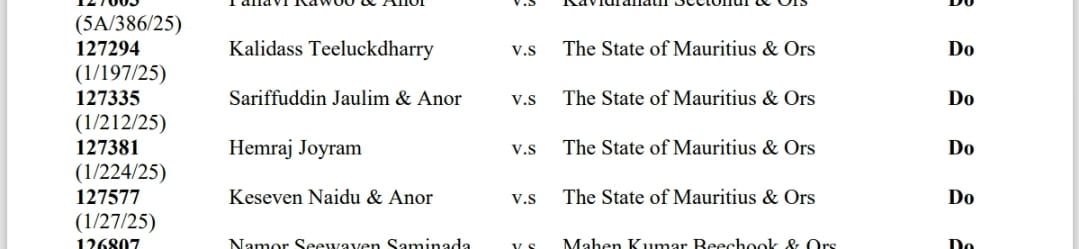
The Basic Retirement Pension (BRP) remains one of Mauritius’ most sensitive and socially important benefits, impacting more than 238,000 senior citizens. Tomorrow, the Supreme Court will hear four separate challenges against the amendments made to the BRP by the current administration. These constitutional cases—filed by different citizens and interest groups—raise serious questions about legality, fairness, financial sustainability, and political motives behind the changes.Below are the four biggest issues the Supreme Court will examine.
Constitutionality of the BRP Amendments
One of the strongest challenges raised concerns the constitutional protection of social benefits.Applicants argue that:The BRP has historically been a universal right, not a means-tested benefit.Changing the structure of the pension may infringe on legitimate expectations of citizens who planned their retirement based on BRP continuity.Government may have acted ultra vires if the amendments conflict with constitutional guarantees of equality or protection of property (which includes acquired benefits).This challenge asks the Court to determine whether Parliament crossed its constitutional boundaries when redefining pension entitlements
Alleged Discrimination and Unequal Treatment
Several applicants argue that the new BRP formula creates different categories of pensioners, resulting in discriminatory treatment.Key claims include:Pensioners who contributed more—or who worked for longer—may now receive less than expected.Different age groups may be treated differently, which could violate Section 16 of the Constitution (non-discrimination).Citizens argue that their age, income bracket, or employment history should not reduce their right to a universal pension.The Court will consider whether the new BRP model unfairly disadvantages certain groups, especially low-income pensioners.
3. Lack of Transparency and Procedural Fairness
A major point raised in the cases is the lack of consultation or public disclosure before the changes were implemented.Applicants argue:There was no proper public consultation, despite the fact that the BRP affects nearly every Mauritian family.The decision-making process was rushed and may violate the principles of natural justice.Pensioners were not given adequate notice, affecting financial planning and trust in state institutions.This challenge focuses on the process, not just the policy—testing whether government acted fairly before altering long-standing national benefits.-
The Financial Sustainability and Policy Legitimacy Challenge
Another group of applicants questions whether the reforms are genuinely aimed at making the BRP “more sustainable,” or whether they are politically motivated cost-cutting measures that breach good governance obligations.Key factors raised:Government’s financial arguments may be inconsistent with official budget projections and past spending trends.If the policy is not grounded in transparent economic analysis, it may fail the test of rationality, a key standard under administrative law.Applicants argue that reforms cannot be justified if they disproportionately burden future pensioners while leaving inefficiencies untouched.This challenge asks the Supreme Court to examine whether the BRP amendments are based on sound policy, or whether they violate the principles of proportionality and good administration.
What Happens Next?
The Supreme Court hearing tomorrow marks a critical moment for social protection in Mauritius.
Possible outcomes include:
Upholding the changes
Striking down the amendments as unconstitutional
Ordering the State to redo the process with proper consultation
Issuing interim relief to protect current pensioners
Whatever the decision, the ruling will have national implications—legally, socially, and politically. With pensions being one of the country’s most sensitive issues, all eyes will be on the Court as it evaluates the fate of Mauritius’ most important social benefit.
Conclusion
The four challenges to the BRP reforms highlight a deeper national debate:How should Mauritius balance financial sustainability, constitutional rights, and the dignity of its senior citizens?Tomorrow’s Supreme Court hearing will be a defining moment in this debate. As thousands of families wait anxiously, the decision could reshape the future of the Basic Retirement Pension—and the lives of the elderly—for years to come.
Views: 7