

Creole in the National Assembly: A Constitutional Debate Shaping Mauritius’ Identity
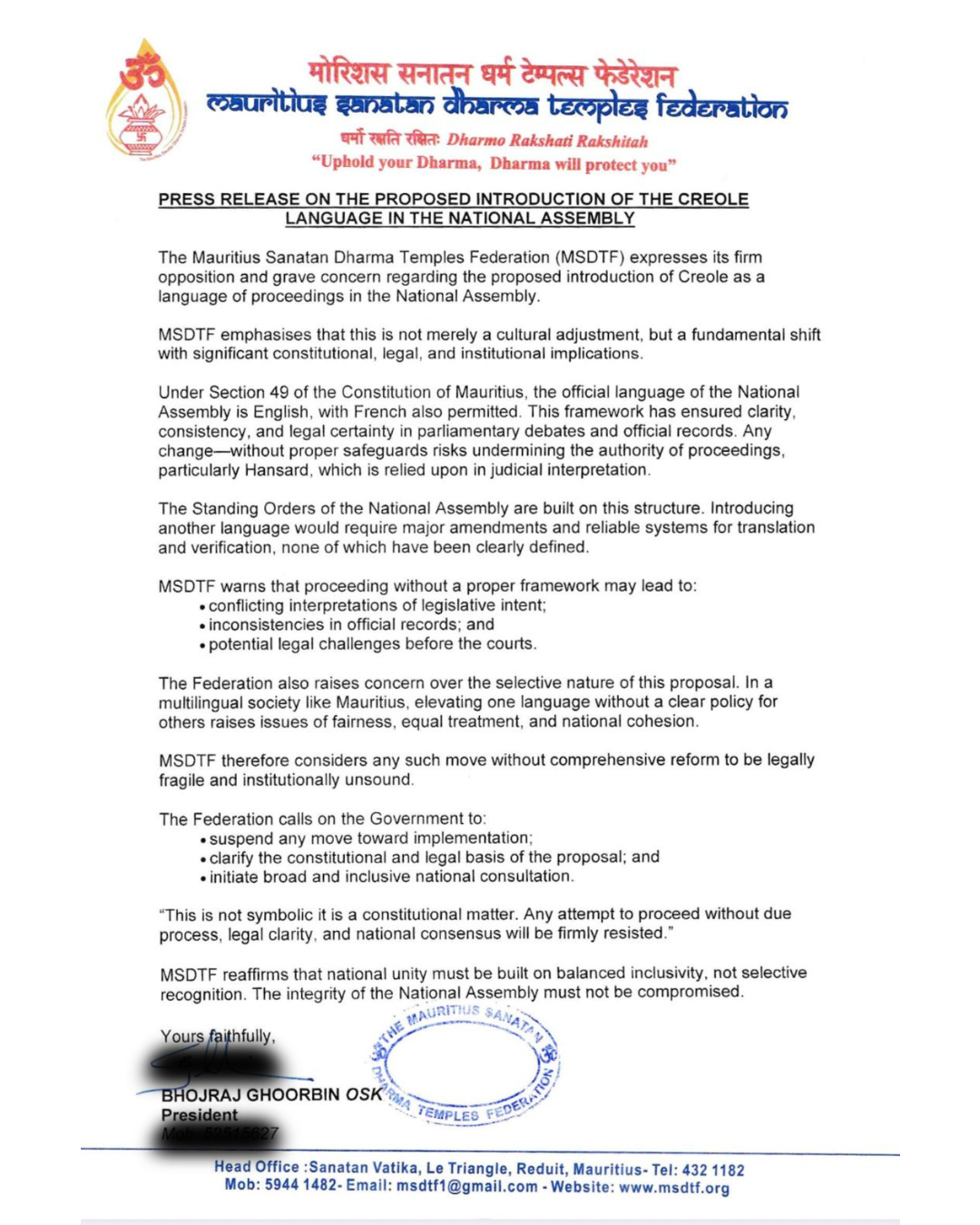
The recent press release issued by the Mauritius Sanatan Dharma Temples Federation (MSDTF) marks a significant moment in the ongoing national debate over the proposed introduction of Mauritian Creole (Kreol Morisien) as a language of proceedings in the National Assembly. Far from being a purely linguistic reform, the issue has evolved into a deeper constitutional, cultural, and political question—one that is now drawing clear lines across socio-religious organisations such as Arya Sabha Mauritius and the Gahlot Rajput Sabha.
A Constitutional and Institutional Concern
At the heart of MSDTF’s position lies a strict interpretation of the Constitution. Section 49 explicitly states that English is the official language of the National Assembly, with French permitted under certain conditions (Mauritius National Assembly). This framework, MSDTF argues, is not arbitrary—it ensures legal clarity, consistency in parliamentary records, and reliability of Hansard for judicial interpretation.
Their warning is clear: introducing Creole without a robust legal and procedural framework risks:
- conflicting interpretations of laws,
- inconsistencies in official parliamentary records,
- and potential legal challenges in court.
This concern is not unfounded. Mauritius operates within a Westminster-style parliamentary democracy where precision in legislative language is critical (Wikipedia). Any ambiguity in parliamentary debates can have downstream effects on governance, judicial rulings, and constitutional interpretation.
The Sociolinguistic Reality: Creole as Lingua Franca
Yet, the debate cannot ignore the sociolinguistic reality of Mauritius. Mauritian Creole is spoken by the vast majority of the population and functions as the country’s lingua franca (Wikipedia). In everyday life, it is the most accessible and widely understood language, cutting across ethnic and religious lines.
This creates a tension between:
- institutional language (English/French) – associated with governance, law, and education, and
- popular language (Creole) – associated with identity, accessibility, and lived experience.
Proponents of Creole argue that introducing it in Parliament would democratise debate, making governance more inclusive and understandable to ordinary citizens.
MSDTF’s Position in Context
The MSDTF’s stance is not merely linguistic—it reflects a broader ideological position grounded in:
- constitutional conservatism,
- institutional stability,
- and concern for balanced multicultural recognition.
The Federation also raises an important equity issue: why elevate one language (Creole) without a clear framework for others? In a country where multiple ancestral languages—Hindi, Tamil, Telugu, Urdu, and others—are tied to religious and cultural identity, selective recognition risks being perceived as politically or culturally biased.
Alignment with Arya Sabha Mauritius
The position of Arya Sabha Mauritius broadly aligns with MSDTF on several key principles:
- Preservation of Ancestral Languages
Arya Sabha has historically emphasised the importance of Hindi and Sanskrit as carriers of Vedic knowledge and cultural continuity. A shift toward Creole dominance in formal institutions may be seen as further marginalising these languages. - Structured Reform over Symbolism
Like MSDTF, Arya Sabha tends to favour structured, consultative reforms rather than symbolic or politically driven changes. The call for national consultation in the MSDTF statement mirrors Arya Sabha’s traditional approach to socio-cultural policy. - Balanced Multiculturalism
Arya Sabha’s philosophy supports a pluralistic model where all communities retain linguistic and cultural space. The selective elevation of Creole without parallel recognition mechanisms for other languages would likely be viewed as inconsistent with this model.
Position of Gahlot Rajput Sabha
The Gahlot Rajput Sabha, while less publicly vocal on linguistic policy, typically aligns with broader Sanatan and cultural preservationist positions. Their likely stance can be inferred along three lines:
- Cultural Continuity and Identity
Rajput organisations often emphasise heritage, lineage, and cultural preservation. This includes maintaining links to ancestral languages and traditions. - Skepticism Toward Rapid Institutional Change
Similar to MSDTF, there is likely caution against reforms that could disrupt established constitutional or institutional norms without clear safeguards. - Support for Inclusivity—But Not Exclusivity
The Sabha would likely support broader accessibility in governance but oppose any move perceived as privileging one cultural-linguistic identity over others.
The Underlying National Question
This debate ultimately raises a deeper question:
What does inclusivity mean in a multilingual, multicultural state like Mauritius?
- Is inclusivity achieved by elevating the most widely spoken language (Creole)?
- Or by maintaining a neutral institutional framework (English/French) while protecting all cultural languages equally?
MSDTF, Arya Sabha, and similarly the Gahlot Rajput Sabha lean toward the second interpretation—institutional neutrality combined with cultural pluralism.
The Way Forward: Reform or Risk?
The MSDTF does not reject Creole outright; rather, it insists on:
- constitutional clarity,
- legal safeguards,
- and national consensus.
This is a crucial distinction. The issue is not whether Creole has value—it clearly does—but whether its integration into the highest legislative body of the country can be done without undermining legal certainty and social balance.
The government’s own initiatives, such as translating Standing Orders into Creole, suggest that gradual integration may already be underway (Government of Mauritius). However, the leap from translation to full parliamentary usage is significant—and, as MSDTF argues, must be carefully managed.
Conclusion
The MSDTF press release is not a rejection of Creole in Parliament; it is a call for constitutional discipline, institutional integrity, and balanced inclusivity.
When viewed alongside the positions of Arya Sabha Mauritius and the Gahlot Rajput Sabha, a coherent bloc emerges—one that supports cultural diversity but resists reforms perceived as:
- legally premature,
- institutionally risky,
- or selectively inclusive.
In a nation where language is deeply tied to identity, history, and power, the debate over Creole in the National Assembly is not just about words—it is about the future direction of Mauritian democracy itself.
Views: 14