

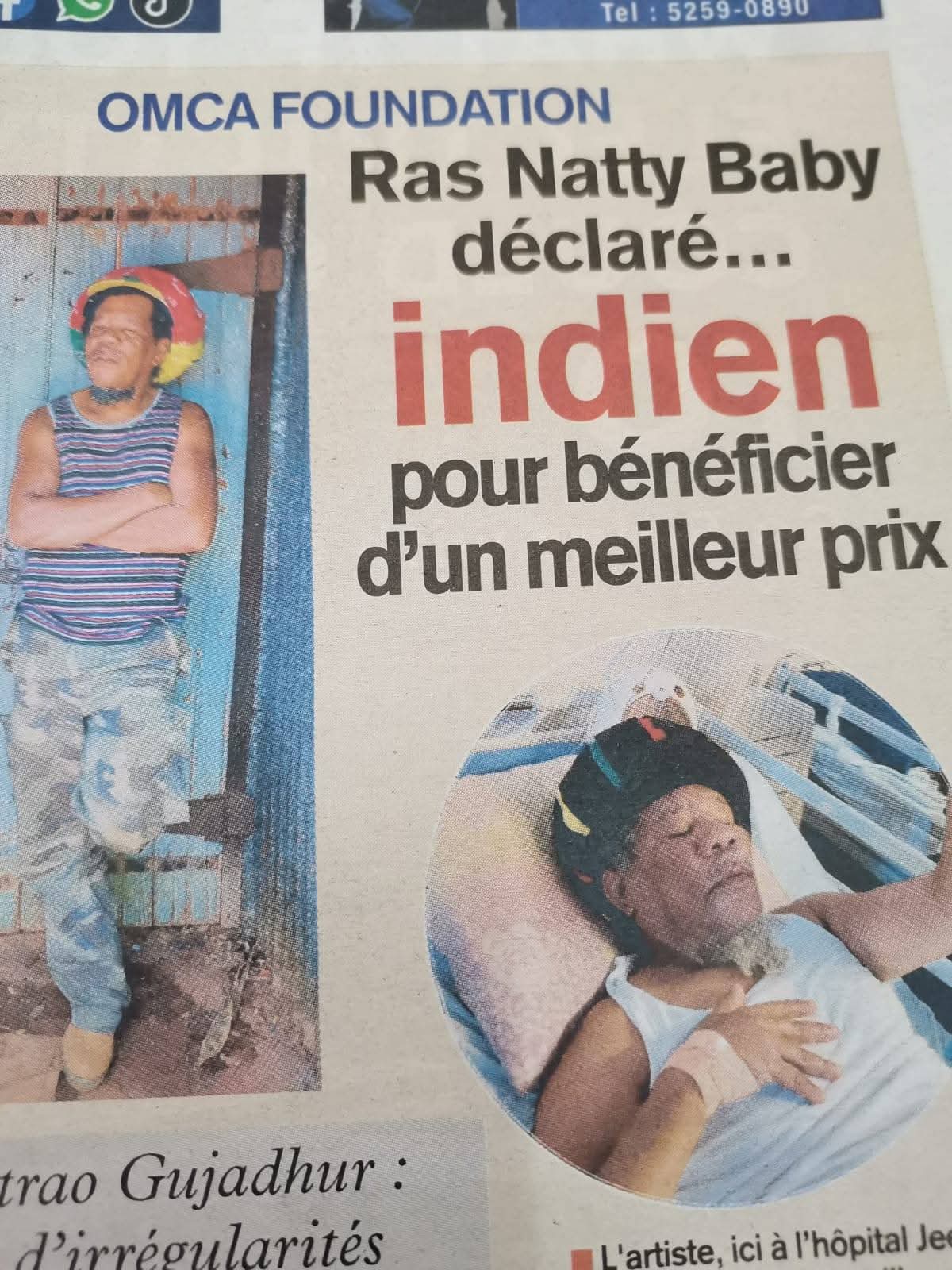
Identity for Sale? Ras Natty Baby Case Sparks National Outrage Over Identity Misrepresentation and Medical Evacuation Profits
“Nationality: India, Religion: Hindu”
Documents Deepen Scrutiny of OMCA and Overseas Medical TransfersSubheadlineAs investigations intensify around OMCA Foundation, the late Ras Natty Baby’s medical transfer documents have ignited wider concerns about identity manipulation, humanitarian fundraising, and the lucrative business of overseas medical evacuations.
PORT LOUIS, Mauritius —What began as public mourning over the death of Mauritian artist Ras Natty Baby has evolved into one of the most disturbing ethical controversies in recent memory.
At the centre of the outrage are medical transfer documents reportedly linked to his evacuation abroad, showing the Mauritian artist classified as:“Nationality: India”“Religion: Hindu”
The revelations have triggered shock across Mauritius, not only because Ras Natty Baby was Mauritian, but because many now suspect the classification may not have been accidental.For critics of the overseas medical evacuation industry, the case has become symbolic of something much larger: the alleged commodification of identity itself in pursuit of financial gain.
A Controversy That Exploded Beyond One Document
The issue erupted publicly after newspaper reports highlighted inconsistencies in documentation associated with the artist’s proposed medical transfer to India.The timing could hardly have been worse for OMCA Foundation, which is already facing mounting scrutiny over its operations, fundraising practices, and financial model.
In recent months, tensions between OMCA and the Ministry of Health have intensified amid growing public debate over:overseas medical evacuations,private-sector influence in healthcare,donation transparency,and the growing commercial ecosystem surrounding desperate patients and emotional fundraising campaigns.
The controversy escalated further after reports emerged that the Financial Crimes Commission (FCC) had opened inquiries linked to OMCA’s activities and financial operations. (lexpress.mu)
The Question Many Mauritians Are Asking
Why would a Mauritian patient be declared “Indian”?
And why would religion even become part of such a classification process?
Within public debate, one explanation is increasingly circulating: that identity classification may allegedly influence pricing structures, administrative channels, sponsorship pathways, or facilitation arrangements linked to overseas treatment.
Several medical evacuation operators privately acknowledge that pricing structures for international patients can vary considerably depending on nationality, referral systems, intermediary arrangements, and institutional partnerships.
Critics now fear that identity categories themselves may have become commercial tools.“This is not just about one patient,” said one healthcare observer familiar with overseas treatment coordination. “If identity is being altered to obtain financial advantages, that crosses a moral red line.”
The inclusion of “Hindu” has proven particularly sensitive.Mauritius is a multi-cultural society where religion carries deep personal and ancestral significance. Many observers argue that reducing religious identity to an administrative or financial variable represents a profound ethical breach.
“This transforms identity into a transactional instrument,” one community figure said. “People are asking whether cultural and religious labels are now being monetised.”
Growing Anger Over the Economics of Medical Suffering
The Ras Natty Baby revelations have also revived longstanding allegations surrounding the profitability of overseas medical facilitation.Within healthcare circles, OMCA has frequently been criticised by competitors and former insiders over pricing structures and margins allegedly charged during medical evacuation coordination.
Several sources in the sector claim that patients and donors often pay substantially higher overall costs compared to competing facilitators.Industry figures interviewed by local observers have alleged that OMCA’s packages can exceed competing quotations by margins reportedly reaching 30% or more in certain cases, although exact figures vary and independent forensic audits have not yet been publicly released.
The issue has become even more explosive because of parallel allegations circulating online and within political circles claiming that public donations and humanitarian fundraising campaigns may have indirectly supported private healthcare expansion and business interests.Those allegations intensified after documents and discussions surfaced linking fundraising ecosystems to broader healthcare commercialisation projects, including reported involvement in private hospital investment structures.No court has yet established criminal wrongdoing in relation to those allegations. However, the perception that humanitarian emotion may have become intertwined with aggressive commercial expansion has severely damaged public trust.
Humanitarian Branding Under Scrutiny
OMCA built much of its public image around emotionally charged appeals: critically ill patients, urgent transfers, children requiring surgery, and dramatic fundraising campaigns amplified across social media.For years, many Mauritians donated generously believing they were participating in acts of compassion and national solidarity.Supporters of the organisation insist OMCA has helped numerous families obtain treatment they otherwise could never have accessed.But critics now argue that the humanitarian branding may have shielded deeper structural questions from scrutiny.The growing backlash reflects a wider discomfort with the transformation of suffering into a high-revenue ecosystem involving:
foreign hospitals, intermediaries, facilitators, logistics providers, referral arrangements, and donation-driven publicity campaigns. Several observers now warn that emotionally vulnerable families may lack the expertise needed to evaluate:real hospital costs,intermediary margins,commission structures,or whether overseas treatment is always medically necessary.
Ministry Tensions and Public Distrust
The Ministry of Health’s increasingly tense relationship with OMCA has further amplified the controversy.Public disagreements over medical evacuation systems, coordination authority, and overseas treatment pathways have exposed a deeper institutional conflict between:public healthcare governance,and private humanitarian-medical networks operating with enormous emotional influence.
The Ras Natty Baby case has now become the flashpoint through which many Mauritians are reassessing the entire sector.For some, the issue is fundamentally about transparency.For others, it is about dignity.And for many, it is about a painful question now echoing across the country:At what point does humanitarian assistance stop being compassion — and become a business model built on desperation, identity, and public emotion?
Views: 30