

From alcohol consumption to public indecency near the Mangal Mahadev statue, repeated controversies at Mauritius’ holiest Hindu pilgrimage site are fuelling nationwide concern.
PORT LOUIS, Mauritius —A formal intervention by the Mauritius Sanatan Dharma Temples Federation (MSDTF) has reignited national debate over what many devotees describe as a decade-long pattern of disrespectful behaviour at Ganga Talao, the island’s most sacred Hindu pilgrimage site.
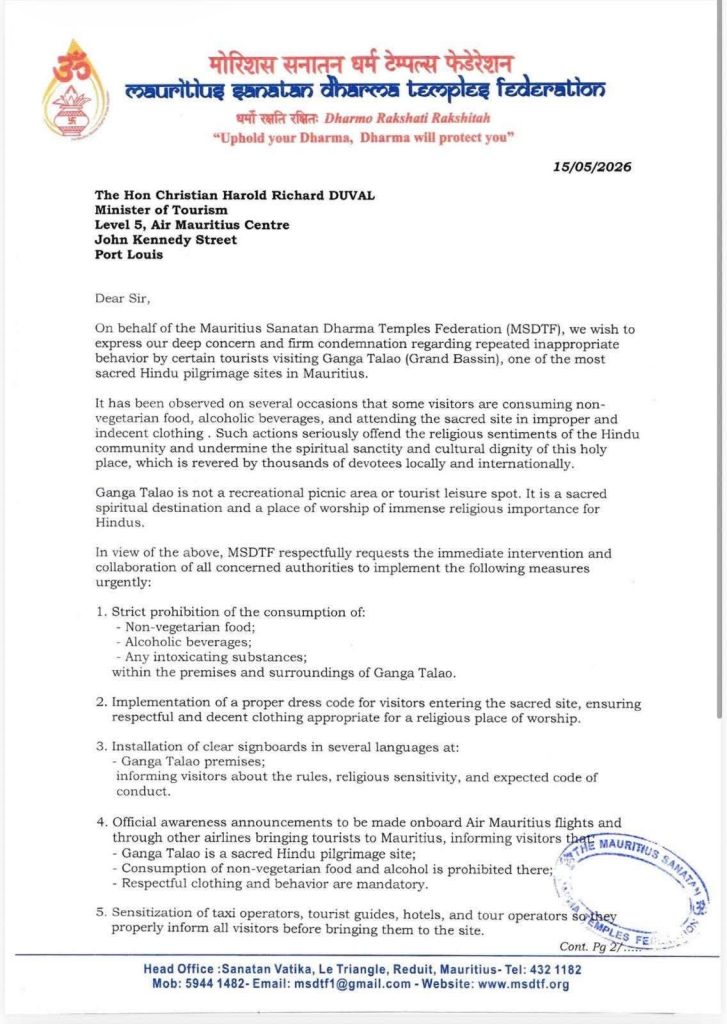
In a strongly worded letter addressed to Tourism Minister Richard Duval on 15 May 2026, the Federation warned that repeated incidents involving tourists and visitors are threatening the sanctity, dignity, and spiritual atmosphere of the sacred lake known internationally as Grand Bassin.The letter comes after years of mounting frustration within the Hindu community over incidents ranging from alcohol consumption and meat eating to indecent behaviour near places of worship.
For many devotees, the latest controversy is no longer viewed as isolated misconduct, but part of a broader failure to properly protect one of Mauritius’ most important religious and civilisational landmarks.
Public Memory Still Haunted by Mangal Mahadev Incident
Among the incidents that triggered widespread outrage was a 2025 episode involving a foreign tourist near the iconic Mangal Mahadev Shiva statue.According to widely circulated reports and social media accounts, a Hungarian visitor was allegedly caught engaging in highly indecent behaviour near the sacred complex, including urinating near the statue area. Other accounts circulating online alleged even more degrading conduct. The incident sparked national condemnation and intense anger among devotees, many of whom considered the act profoundly humiliating for the Hindu community. The Mangal Mahadev statue is not an ordinary tourist monument. Standing 108 feet high at the entrance of Ganga Talao, it represents one of the most recognisable spiritual symbols in Mauritius and a major landmark of Hindu devotion in the Indian Ocean region. For many Mauritians, the incident crossed a psychological line.
“What would happen if this occurred inside a cathedral, mosque, or synagogue?” asked one devotee present during recent prayers at the site. “Respect for sacred places cannot be selective.”
A Decade of Repeated Complaints
The current controversy did not emerge overnight.Over the past ten years, Hindu organisations, pilgrims, and cultural groups have repeatedly raised alarms about inappropriate conduct at Ganga Talao.
Among the documented complaints:
- tourists consuming alcohol near the sacred lake;
- visitors eating non-vegetarian food on site;
- revealing or inappropriate clothing during visits;
- Loud music and disruptive behaviour;
- Insensitive photography during prayers and rituals;
- Misuse of the sacred environment as a leisure or picnic destination.
In 2021, public criticism intensified after videos and images circulated showing individuals consuming alcohol and behaving disrespectfully at the site, triggering widespread backlash across Mauritian society. Community organisations and online Hindu advocacy groups have repeatedly warned that the absence of clear enforcement has gradually normalised inappropriate behaviour at the sacred site. The issue has become particularly sensitive because Ganga Talao occupies a unique place in Mauritian history and identity.
More Than a Religious Site
Ganga Talao is regarded as the spiritual heart of Mauritian Hinduism.Each year during Maha Shivaratri, hundreds of thousands of pilgrims walk barefoot across the island carrying kanwars in one of the largest religious pilgrimages in the Indian Ocean region. The sacred lake symbolises the endurance of the descendants of indentured labourers who preserved their traditions, rituals, and civilisational memory despite colonial hardship.For many devotees, disrespect toward the site is therefore experienced not merely as bad tourist behaviour, but as an insult to heritage, ancestry, and faith itself.This explains why the MSDTF letter adopted unusually firm language.
The Federation stated that Ganga Talao “is not a recreational picnic area or tourist leisure spot,” and warned that repeated incidents “seriously offend the religious sentiments of the Hindu community.”
Federation Calls for Immediate Measures
The MSDTF has now called for a series of urgent actions, including:
- strict prohibition of meat, alcohol, and intoxicating substances near the sacred premises;
- enforcement of a respectful dress code;
- multilingual signage explaining religious sensitivities;
- awareness announcements onboard incoming flights;
- sensitisation of taxi operators, hotels, and tour guides before bringing tourists to the site.
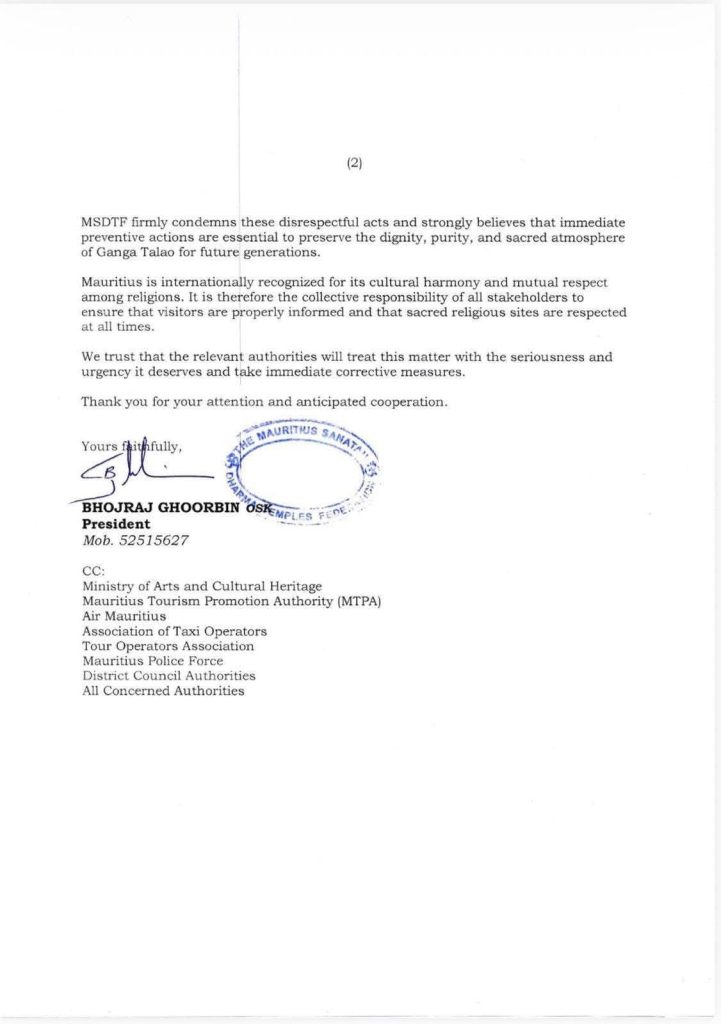
The Federation also copied its letter to the Ministry of Arts and Cultural Heritage, the Mauritius Tourism Promotion Authority, Air Mauritius, police authorities, and district councils.Importantly, the organisation framed the issue not as hostility toward tourism, but as a matter of mutual respect and national cohesion.
“Mauritius is internationally recognised for its cultural harmony and mutual respect among religions,” the letter stated.
A Test for Cultural Preservation
The controversy is increasingly raising difficult national questions.Mauritius actively markets its multicultural identity to the world. But many observers now argue that multiculturalism cannot survive if sacred spaces are treated casually or stripped of the respect normally afforded to religious sites internationally.Around the world, visitors are expected to follow strict codes of conduct at churches, mosques, temples, monasteries, and heritage sanctuaries.Many Mauritians are now asking whether Ganga Talao deserves the same seriousness.For devotees gathering at the sacred lake this week, the issue is becoming urgent.
“This is not extremism,” said one pilgrim quietly while offering prayers near the lake. “It is simply asking people to respect what is sacred to others.”
Views: 25