

A major linguistic debate is unfolding in Mauritius—one that touches identity, governance, and national unity.
The proposal to introduce Creole in the National Assembly has triggered a strong response from Arya Sabha Mauritius.
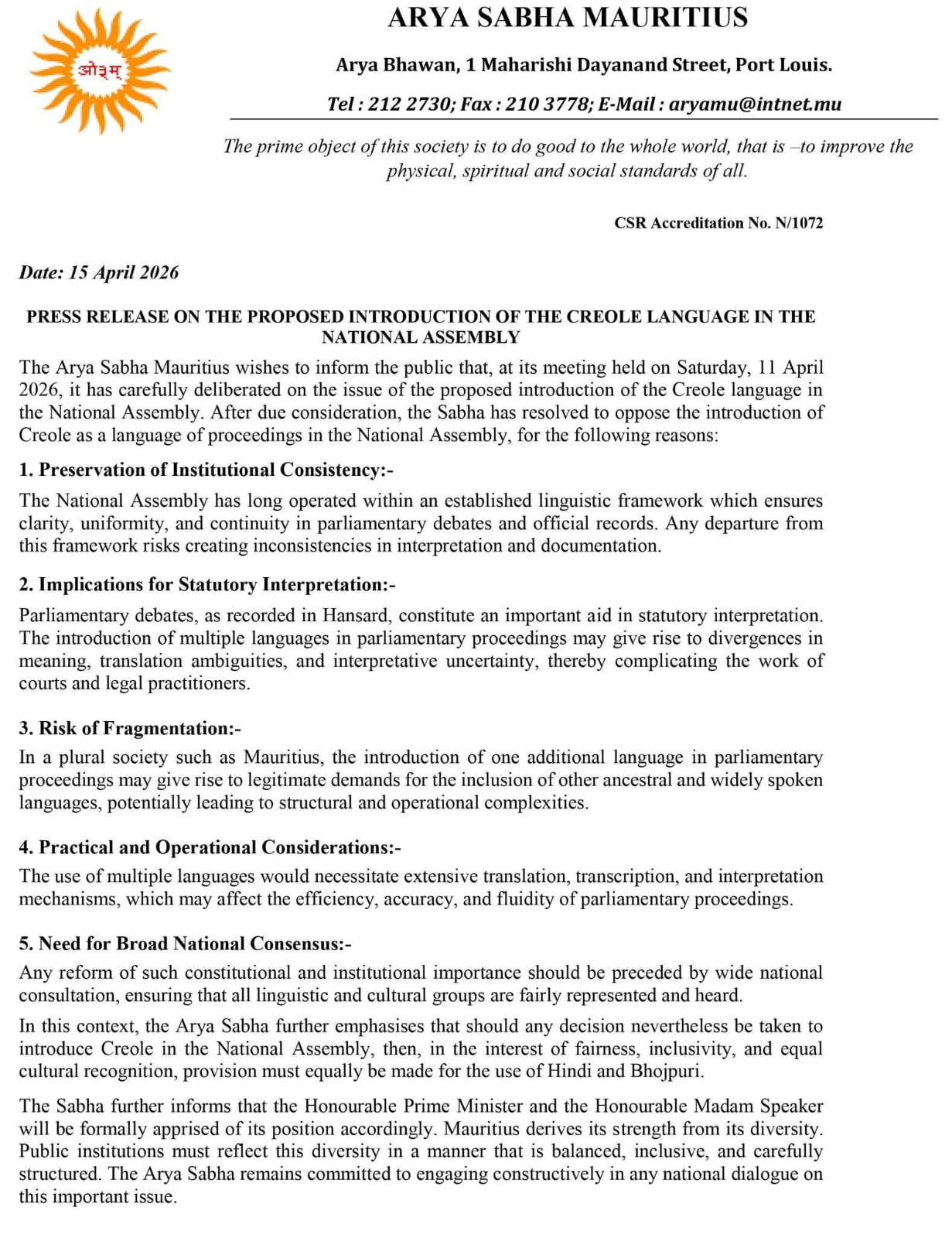
On 15 April 2026, Arya Sabha Mauritius, based in Port Louis, issued an official press release opposing the proposed introduction of the Creole language in the National Assembly.
The decision follows deliberations held on 11 April 2026, where the Sabha carefully examined the implications of such a move on parliamentary proceedings and national cohesion.
Preservation of Institutional Consistency
Arya Sabha emphasised that the National Assembly has long functioned within a stable linguistic framework.
This framework ensures:
- Clarity in debates
- Uniformity in records
- Continuity in governance
Any deviation, the Sabha warns, could lead to inconsistencies in interpretation and documentation.
Legal and Statutory Concerns
The Sabha highlighted the critical role of parliamentary records (Hansard) in legal interpretation.
Introducing multiple languages could:
- Create translation ambiguities
- Lead to differing meanings in legal contexts
- Complicate judicial processes
This, according to the Sabha, may directly affect courts and legal practitioners.
Risk of Linguistic Fragmentation
Mauritius is a richly diverse society with multiple ancestral languages.
Arya Sabha cautions that introducing Creole alone could:
- Trigger demands for inclusion of other languages
- Lead to structural complexity in governance
- Create potential divisions rather than unity
Operational and Practical Challenges
The Sabha also raised concerns about the logistical implications of multilingual proceedings.
These include:
- Need for extensive translation systems
- Increased transcription workload
- Risk to efficiency and accuracy in debates
Such changes could slow down parliamentary functioning significantly.
Call for National Consensus
Arya Sabha stressed that any reform of this magnitude must be preceded by broad national consultation.
The organisation insists that:
- All linguistic and cultural groups must be heard
- Decisions must reflect fairness and inclusivity
Importantly, the Sabha added that if Creole is introduced, equal provision must be made for Hindi and Bhojpuri.
Key Position:
Arya Sabha Mauritius firmly opposes the introduction of Creole as a parliamentary language unless a balanced, inclusive, and nationally agreed framework is established—potentially including Hindi and Bhojpuri alongside it.
What do you think about the use of Creole in Parliament?
Should Mauritius adopt a multilingual parliamentary system? Share your views and join the national conversation.
As Mauritius navigates this sensitive issue, the balance between identity, inclusivity, and institutional integrity will define the nation’s next chapter.
Views: 13