

A growing language debate is stirring deep constitutional and cultural questions in Mauritius.
The proposal to introduce Creole in the National Assembly has triggered strong reactions — and now, a prominent socio-cultural body has stepped forward with serious concerns.
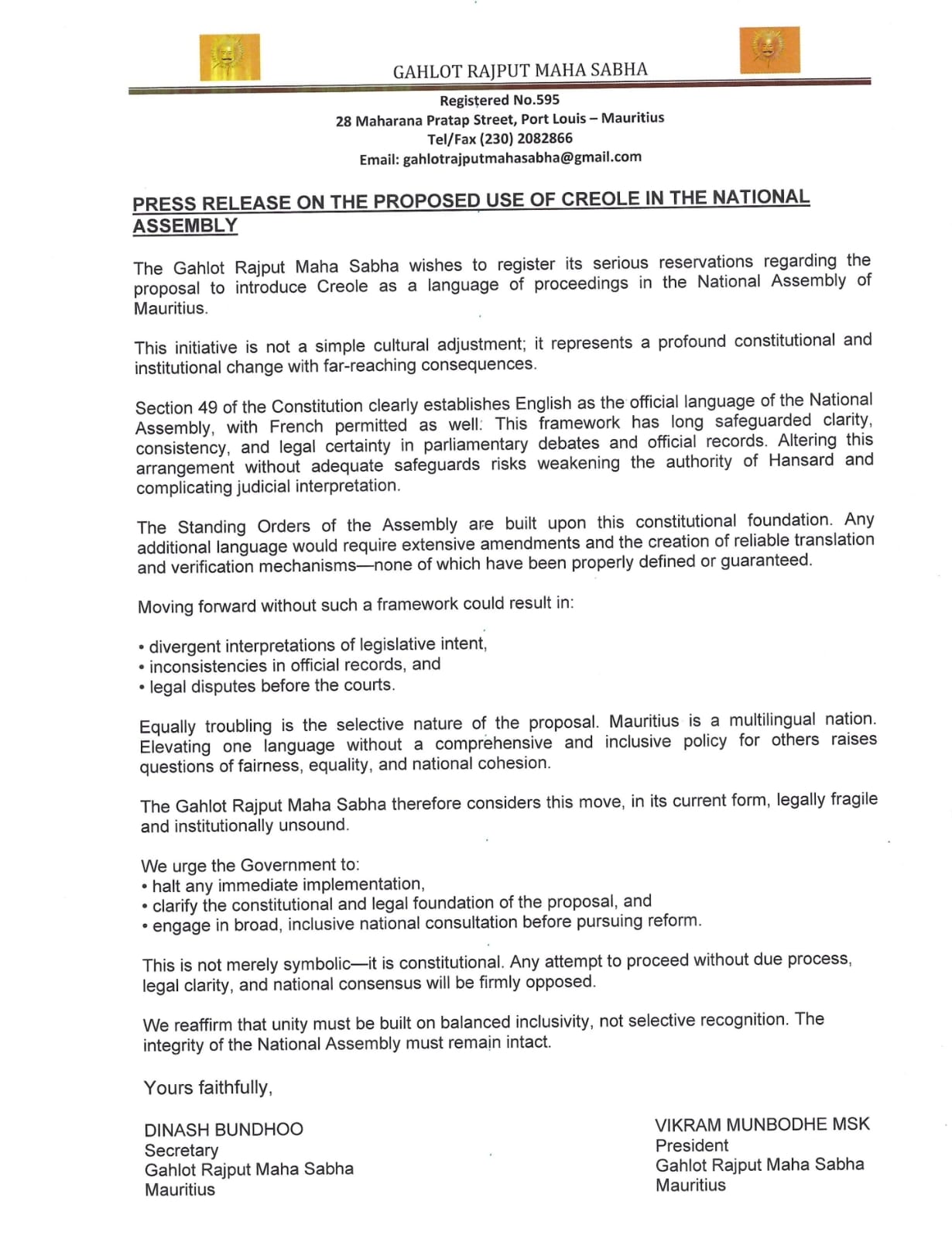
On April 2026, in Port Louis, Mauritius, the Gahlot Rajput Maha Sabha issued an official press release opposing the proposed use of Creole language in the National Assembly.
The organisation warned that the move is not merely symbolic, but a major constitutional shift with potential legal, institutional, and national implications.
Constitutional Concerns Over Creole Language in Mauritius
The Sabha highlighted that Section 49 of the Mauritian Constitution clearly establishes:
- English as the official language of the National Assembly
- French as a permitted language
According to the press release, this framework has historically ensured:
- Clarity in parliamentary debates
- Consistency in official records
- Legal certainty in judicial interpretation
Introducing Creole without a robust legal framework, they argue, could weaken the authority of Hansard records and complicate legal proceedings.
Risks of Introducing Creole in the National Assembly
The organisation outlined several potential risks if the reform proceeds without proper safeguards:
- Divergent interpretations of legislative intent
- Inconsistencies in official parliamentary records
- Increased legal disputes in courts
They also stressed that the current Standing Orders of the Assembly are built on the existing constitutional language structure, and any change would require extensive amendments.
Multilingual Balance and National Unity
Mauritius is a multilingual society, and the Sabha raised concerns about fairness and inclusivity.
They warned that elevating one language without a comprehensive policy for others could:
- Undermine national cohesion
- Raise questions of equality and representation
- Create perceptions of selective recognition
“This is not merely symbolic — it is constitutional.”
The Sabha firmly stated that any attempt to proceed without:
- Legal clarity
- Due process
- National consensus
will face strong opposition.
Sabha’s Key Demands to Government
The Gahlot Rajput Maha Sabha urged authorities to:
- Halt immediate implementation
- Clarify the constitutional basis of the proposal
- Engage in broad national consultation
They described the current proposal as “legally fragile and institutionally unsound.”
As the Creole language debate unfolds, citizens, policymakers, and cultural organisations are being called upon to engage in informed dialogue and ensure that any reform reflects both constitutional integrity and national unity.
In a nation built on diversity, the challenge remains: how to embrace linguistic identity without compromising the foundations of law and unity.
Views: 10