

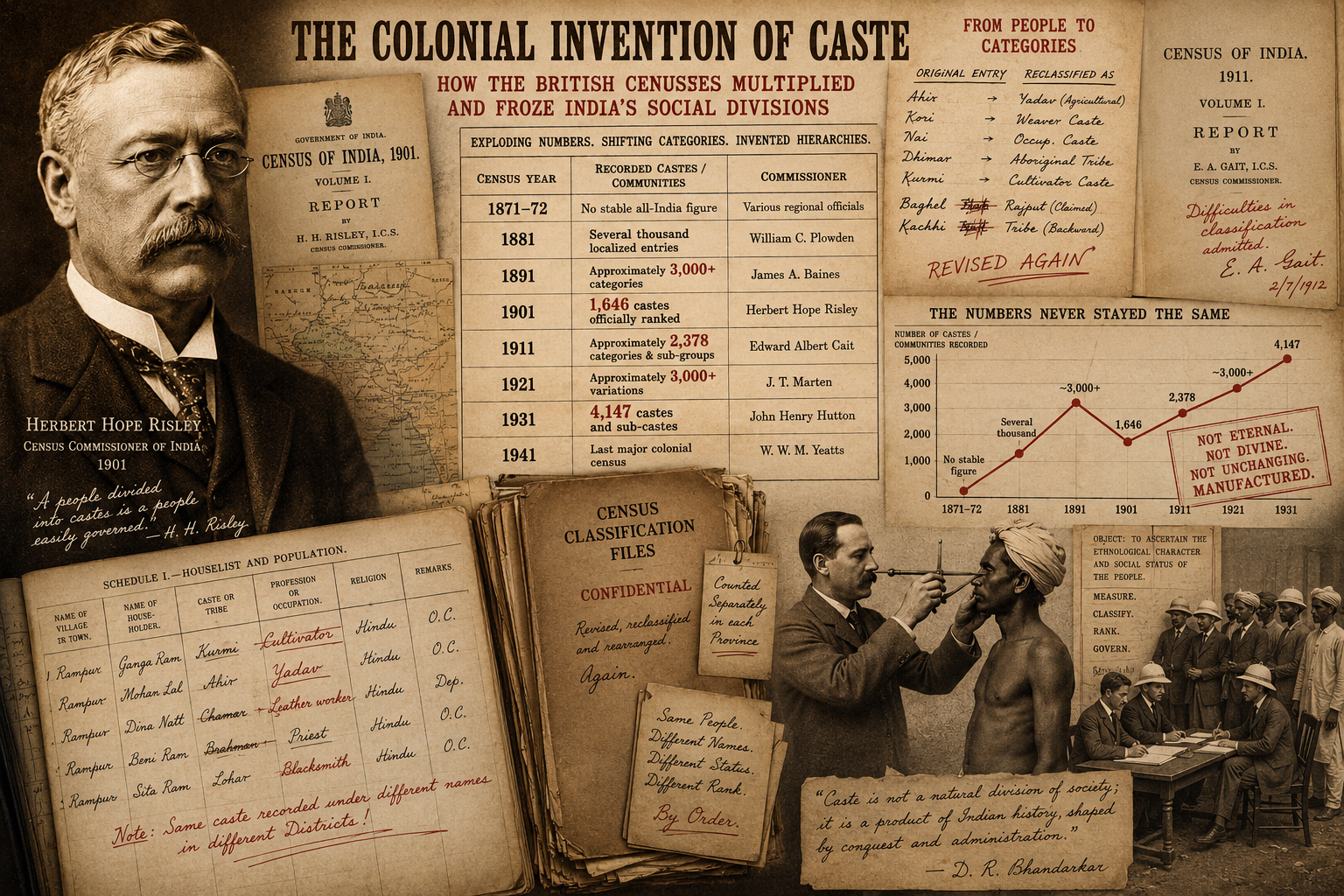
How Colonial Bureaucrats, Racial Theories, and a Trading Company Helped Construct the Modern Bureaucratic “Caste System”
“The British did not merely count India. They categorized it, ranked it, racialized it, and then called the result ancient.”
Prologue: When a Trading Company Attempted to Reorganize a Civilization
In 1600, a group of London merchants formed a commercial corporation to trade spices, textiles, dyes, silk, cotton, and commodities.
That corporation was the East India Company.
Its purpose was profit.
Not sociology.
Not anthropology.
Not philosophy.
Not understanding Indian civilization.
By the late eighteenth century, after the Battles of Plassey (1757) and Buxar (1764), the Company had transformed from a trading enterprise into the ruler of vast parts of India.
Merchants became governors.
Accountants became administrators.
Military officers became social engineers.
And these men now attempted something extraordinary:
They attempted to classify Indian civilization.
The consequences of that attempt still affect South Asia today.
Historian Nicholas Dirks later summarized this transformation powerfully in his landmark work Castes of Mind:
“Colonialism made caste what it is today.”
Dirks did not argue that social divisions did not exist before colonialism. Rather, he argued that colonial administration transformed caste into the dominant organizing principle of Indian society through enumeration, codification, and bureaucratic governance.
This distinction is crucial.
The argument of this article is not that pre-colonial India was a utopia without hierarchy or social distinction.
Historical evidence clearly demonstrates that:
• hereditary occupations existed
• social restrictions existed in some regions
• endogamy existed in many communities
• local hierarchies existed
However, the evidence also demonstrates that the colonial state transformed localized, overlapping, fluid, and regionally variable identities into a rigid pan-Indian bureaucratic system called “caste.”
That distinction matters enormously.
1. India Before Colonial Enumeration: A Dynamic Civilizational Framework
Before colonial censuses, Indian society did not function through a single rigid all-India hierarchy called “caste.”
Instead, identity existed through multiple overlapping systems.
Varna: Functional and Philosophical
The philosophical concept of varna appears in Hindu texts such as the Bhagavad Gita.
The Gita states:
“Chaturvarnyam maya srishtam guna karma vibhagashah.”
This describes social organization according to:
• guna (qualities)
• karma (actions)
—not race.
Not skull measurements.
Not hereditary biological hierarchy.
Varna represented an idealized philosophical model of social function.
It was not a census category.
It was not a numbered administrative code.
Numerous Hindu reformers, including Swami Vivekananda and Dayananda Saraswati, argued strongly that varna originally referred to qualities and conduct rather than rigid hereditary status.
Jati: Localized Social Communities
Everyday life in India operated through jati communities.
A jati could represent:
• a guild
• an occupational network
• a regional community
• a tribal integration
• a mercantile group
• an artisan cluster
• an agricultural society
Jatis varied across regions.
The same community could hold different social standing in different places.
Communities evolved.
Occupations changed over generations.
Farmers became warriors.
Traders became rulers.
Artisans became landowners.
Mobility existed.
British administrator Denzil Ibbetson, in his influential Punjab Census Report of 1881, explicitly warned colonial authorities against treating caste as a rigid all-India hierarchy. Ibbetson argued that many so-called castes were in reality occupational and tribal communities that evolved historically rather than fixed biological groups.
Ibbetson wrote:
“Caste is far more a matter of social function than of religion.”
This statement alone directly contradicts later rigid racial interpretations.
Kula: Family Lineage
Kula referred to family lineage and ancestral household identity.
It represented kinship structures and inherited family traditions.
Gotra: Genealogical Descent
Gotra traced lineage back to ancient sages.
Its primary purpose was genealogical and marital regulation.
It was not a social ranking system.
Sampradaya: Spiritual Identity
A sampradaya represented spiritual and philosophical lineage:
• Shaiva
• Vaishnava
• Shakta
• Smarta
• other traditions
These identities reflected theology and devotion—not hierarchy.
Timeline of Colonial Enumeration and Social Classification
| Year | Event | Key Figures | Historical Significance |
|---|---|---|---|
| 1770s–1790s | Revenue and district surveys begin | Company tax administrators | Villages and occupations classified for taxation |
| 1784 | Asiatic Society founded | William Jones | Sanskrit texts interpreted through European frameworks |
| 1800–1815 | Regional ethnographic surveys | Francis Buchanan-Hamilton | Communities catalogued region by region |
| 1820s–1850s | Expansion of district ethnographies | Colonial collectors and magistrates | Local identities increasingly frozen into administrative records |
| 1857 | Indian Rebellion | East India Company administration | Crown rule begins in 1858 after Company collapse |
| 1860s | Provincial census experiments | British provincial administrations | Foundation laid for all-India census |
| 1871–72 | First all-India census attempt | Regional commissioners | First major synchronized population enumeration |
| 1881 | First regular synchronous census | William C. Plowden | Census institutionalized every 10 years |
| 1891 | Expansion of caste classification | James Athelstane Baines | Thousands of social groups categorized |
| 1901 | Racialized caste hierarchy census | Herbert Hope Risley | Castes ranked according to racial and social theories |
| 1911 | Revision after protests and confusion | Edward Albert Gait | Officials admit classification difficulties |
| 1921 | Further expansion of caste subdivisions | J. T. Marten | Administrative fragmentation intensifies |
| 1931 | Largest caste enumeration | John Henry Hutton | 4,147 castes and sub-castes recorded |
| 1941 | Wartime census | W. W. M. Yeatts | Last major colonial census |
Growth of Recorded Castes Under Colonial Enumeration
| Year | Recorded Castes / Communities | Commissioner |
|---|---|---|
| 1871–72 | No stable all-India figure | Various regional officials |
| 1881 | Several thousand localized entries | William C. Plowden |
| 1891 | Approximately 3,000+ categories | James A. Baines |
| 1901 | 1,646 castes officially ranked | Herbert Hope Risley |
| 1911 | Approximately 2,378 categories and sub-groups | Edward Albert Gait |
| 1921 | Approximately 3,000+ variations | J. T. Marten |
| 1931 | 4,147 castes and sub-castes | John Henry Hutton |
Selected References and Primary Sources
- Risley, H. H. (1901). The Tribes and Castes of Bengal.
- Risley, H. H. (1901). Census of India 1901, Volume I.
- Ibbetson, D. (1883). Punjab Census Report.
- Baines, J. A. (1893). General Report on the Census of India 1891.
- Gait, E. A. (1913). Census of India 1911.
- Hutton, J. H. (1933). Census of India 1931.
- Dirks, N. (2001). Castes of Mind: Colonialism and the Making of Modern India.
- Cohn, B. (1996). Colonialism and Its Forms of Knowledge.
- Bayly, S. (1999). Caste, Society and Politics in India.
- Dharampal (1983). The Beautiful Tree.
Views: 61